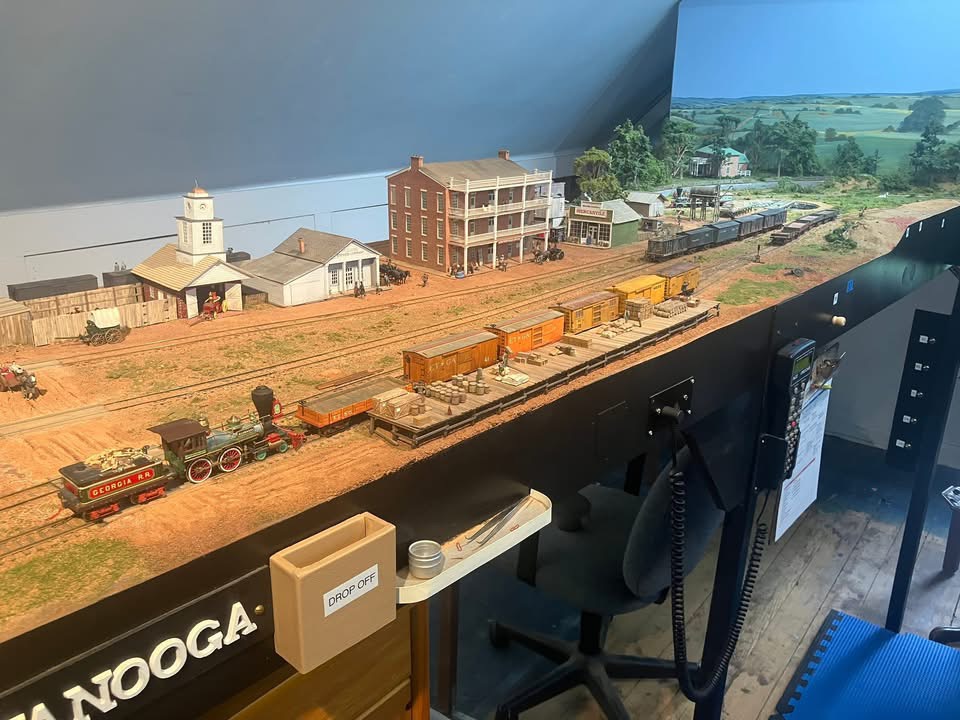
Showing posts with label Crew Scenes. Show all posts

Sunday, August 17, 2025

Operating Session #17

August 12, Trainmen assembled into three crews of two operators each. Bill Myers was assigned to the special running out of Atlanta. A wide range of trains were dispatched, including artillery, mixed, cotton, and hospital. "Random Events" added the unexpected, a wreck train and a telegraph section. Operators also encountered a car with a broken axle, sabateour torching a bale of cotton, officers intervening and demanding two cars off fed and hay dropped on a siding. Bill's special was the spoiler as the other trains had no idea to expect him. Makes for a real-life prototype experience.

After each session, I ask everyone to supply me with highs and lows of their experience. During their runs, they also note where they had issues, e.g., derailments, short, poor loco performance, and anything I need to know for a smooth operation next time.

Here are a few pics from that Saturday...

Corey and Roger are picking up platform cars of cotton in Kingston. Their Random Event was a torched cotton bale, and to uncouple that car.


Here we have Jim on the right, a first timer. He is the Superintendent for our sister NMRA Division, The Garden State. You can read about Jim,  layout updates, and the activities of their division in the Whistle Stop newsletter. Google the NMRA, Garden State Division and their website will pop up. He and Glyn are taking a train through Kingston, on its way to Chattanooga. 


Rob, the engineer, and conductor Dave are making a move in the north end of Big Shanty. Most of you probably know that the Great Locomotive Chase began nearby. By the way, this crew had the car with a broken axle. 


Monday, June 2, 2025

Operating May 31, 2025

We had our 16th op session here two days ago. If you have ever hosted an operating session, you are familiar with the preparation and setup required for a smooth, or relatively smooth, running of the trains. I begin with an email confirming the operators, date, timing, and other incidentals. One example is that we are an inside slipper or sock home; outside shoes are deposited on the inside porch. 

We have an orientation 15 minutes before the first run. I find this is critical to ensure operators are aware of operating nuances. A key one for me is the new hand-thrown switches using a push rod anchored on the fascia:

The rod is attached to the Tortoise switch machine. I plan to add more, as this was a manual railroad. It provides a more active role for the operator. One issue was that I did not allow operators to "practice" using the push rods. Consequently, I would hear the switch machine gears grinding because the operator was pushing and pulling too hard. I will now include a time to practice after a brief instruction.
Here is the Orientation sheet that continues to evolve:

timetable
I find that an orientation, even for operators who have been here a few times, helps anchor them into the time and era as well as new information and how the time table, etc, are to work. 

Below, the Yard Master is building a train with his yard engine, Alabama, for a crew's next run out of Chattanooga:


Switching maneuvers in Dalton with 
two crews negotiating the right-of-way. 
To the right, Dan is functioning as the conductor while a new operator, Andreas, takes position in the cab, figuratively speaking, of course.
Above is a close-up of Dan and Andreas with loco Catoosa.


The first part of the operating session went flawlessly. However, after the first 45 minutes or so, one locomotive was not receiving power, and another had its motor turning but no movement. If the issue is not solvable in a couple of minutes, a replacement loco is acquired. The motor turning one had an issue with the shaft separating. Easy repair with CA super glue. She now became a backup.

This is a pano looking over the south yard in Atlanta, over to Dalton:


And to give you a close-up view on how crews pin the link, as we say, here is a photo by Jim Judge, YM for Chattanooga, showing how it's done. I have found tweezers with LED lights, which help immensely in a dark area of the railroad.


I ask crews to be sure to make notes on their Time Table sheets with any issues, including track repair, car breakdown, and areas where they experienced a short; also to note the actual arrival and departure times. These notes allow me to fix the issues before the next ops.
Bottom line, they continue to come back and enjoy operating and hanging with friends.


Wednesday, May 29, 2024

May Operating Session

Our latest and perhaps one of our most enjoyable train runnin sessions.

Left to right, Andy, Heath, DC, Ted, Rob and Jim. Unfortunately Corey had to leave early.

When planning these sessions, there are always one or two operators that may need to cancel last minute. I lost my mind as I had spent more than a week working out the schedules for two member crews. Another lesson learned... KEEP MY COOL! It worked out great. There were four trains and two had solo operators. This helped me realize that one person can do all the jobs. Now I just need to make a few adjustments to minimize all the paraphernalia an operator needs to carry. Easy! 

This view shows the new ops elements I incorporated into different train orders. The car with derrick is the wreck train with two attached cars. These were mentioned in a couple of writings by trainmen who rode the W&A at the time and other lines such as the VA Central, East TN & GA and GA RR.

Bottom left is a telegraph car. This would take new poles and insulators to set along the line or to replace those needed.

The keg is one of whiskey which seemed appropriate to "support" the troops. Next is a grease bucket, the idea coming from Wilber Kurtz notes that one engineer was asked to meet another train to hand of a bucket of grease. 

Last are pole cars. Lever cars were had not arrived on the W&A in 1863. However, these pole cars were on occasion transported to an area where workers would need to travel down a line to either inspect of conduct minor repairs. 

During this session, each of these were added to a crew's train orders. The feedback was ecstatic as it provided a hands-on experience for the operators.


Tuesday, February 25, 2020

FEB 2020 OPS SESSION / SHAKEDOWN & PEACHTREE ST RENOVATION VIDEO

It's what can happen when my honey decides to go visit one of her friends for more than 4 days... INVITE THE CREW! In addition to DC and Andy, a very good friend and contributor was able to visit as well, LeBron Matthews. One day we will feature his remarkable modeling as he too models the W&A, referenced as the south branch. LeBron is from Columbus Georgia.


This crew was here on Wednesday working on different projects as well as to help prep for the Thursday night ops session. DC continues to scenic the new section. More on this section and DC's work in a future post.

 LeBron scenicing Atlanta; grass was more likely in many areas around the tracks and yard than I considered. Where there is no traffic most likely there'd be grasses. Needless to say, the added greenery has a few effects. 1) it pulls the elements of Atlanta together, the green is the connector to the structures. 2) it fills out the area of Atlanta; makes it "pop" as some like to say.
3) the color adds a pleasing invitation to the eye.

Andy took on his first structure, a Woodlands Scenics casting of the Tack Shed. The door off the hinge was his intention!
Six other fellas came by for the session. Adding LeBron and Paul, we grouped them into four 2-man crews, one engineer and one brakeman. In addition to operating the loco, the engineer handled the way bill/schedule. Brakeman had responsibility for coupling, switching. Here Lebron, engineer, along with his brakeman Paul, maneuver the Dr. Thompson consist into Big Shanty. DC and I were trouble shooters.

Engineers and Brakemen
Left to right, LeBron, DC, Ray, Paul, Bill, TR, Dave, Hilmar, Ed and Andy. Paul, Ed and Hilmar are from our local RR club, Garden State Central. Paul is building an HO scale W&A layout, focusing on the Battle of Mission Ridge. Ray has a MASSIVE HO multi-level layout, Norfolk and Western. Bill and Dave contribute to his layout and all three are members of the Model RR Club. Andy is our resident photographer and videographer. He excels at tree making ,and during this visit apprenticed with LeBron on scenic work.
Lessons learned or reinforced
1) Prior to ops session, have a friend review the schedule/way bills. We found out, 30 minutes prior to people arriving, the schedules included the same cars! During staging this was most apparent as one person set up a consist, went off to do another, only to return and find the cars he set gone!  
2) Always invite guests to offer feedback. Most often they will not offer input to avoid offending. This also shows them that your intention is to improve the efficiency and fun. 
3) Just because a person has done the brakeman job a few times does NOT mean they know how to engineer a locomotive! Although we are familiar with shorts, we had an excessive number this time. Speaking with one engineer at the end, I realized this engineer did not know that he could not run a loco into an adjacent turnout if the rails were not aligned to the track he was exiting! Good news is that this one breakdown indicated that we did not have a massive, layout wide, short issue to untangle.
4) Coupled with number 3, invite operators who are familiar operating on your layout. Then be sure to partner the most familiar with newest guests.
5) The realization that metal wheels can cause a short when the stub rails are either too close or wheel sets are too loose and hitting both rails simultaneously.


Thursday, February 28, 2019

Operations Session

February 21 the W&A hosted its first official ops session! Long time coming it has been. We were honored to have six friends partner up in crews of two, one engineer with a brakeman. 7:00 PM crew members arrived to orient themselves to their schedules and plan their ways of working. 7:30 the clock started and everyone was completed by 9:15. Of course there were many breakdowns that were communicated to the superintendent, providing LOTS of maintenance work orders. But this is to be expected, although he (I) was more disappointed than expected. Bottom line is that it appeared all had a fabulous time.  
Engineers were responsible for operating the locos. Brakemen had responsibilities for coupling, re-railing cars when necessary and ensuring switches were set accurately. 
The schedules were challenging in that the timing of arrivals caused negotiations in order to ensure that their respective time tables were successfully met. 
The image below, with a Yankee who somehow infiltrated as a brakeman, shows Paul with Jimmy at the throttle. Shortly after this shot, another consist came barreling through with DC at the throttle causing one of those "challenging" situations. However, when considering this is 1863, trains were constantly running at all times in order to meet both military and civilian demands. Hence, this was quite prototypical. However, schedule adjustments will be made for the next session.
This next photo has brakeman Christopher questioning engineer Martin's instructions on how best to build their consist in Chattanooga. Martin is a veteran engineer and Christopher... well, this was his first time in this role. He had a steep learning curve, and did quite well.
Below, my good friend from high school and college, Dave Eberhardt, is on his maiden run as a first time brakeman with DC at the throttle. Dave had a layout in the '70's, my first experience helping to build structures and learn a few basics. Here they are building their consist in Atlanta. 
This one below is the opening of the session, two crews setting up their respective runs.
Prior to this evening, one of our favorite modelers and friends, Brian Kammerer visited. It had been quite some time since his last appearance. He did not like a bird I had set into the backdrop because of the shadow. So in his nature for clean imaging, we were able to get him to add a small flock of crows to the backdrop, the latter which he had painted in the early days of layout construction. So good it was to have his rare visit to the W&A. Here is a link to his art work http://www.cwbattlemapart.com 
DC arrived early to complete his scratch build of a prototype fire house in Chattanooga. "Look what I did!" And it is ridiculously exquisite! 
Shorty after, he wanted to see the cars he had built for his own future layout run on our W&A. All was well until he begin to uncouple. He pulled the pins, however, the links were a bit tight in the coupler pockets. As he pulled one car off it pulled the next... HO dominoes resulted! Although there were a couple of casualties, they were easily repaired. Lesson-do NOT uncouple on elevations!
This ops event was a much welcomed achievement given we've been at this since 2003! Using the hindsight factor, I would have ... but hindsight also says there is only so much planning; best is to get into it and be open to learn, adjust and have great friends to share the joy along the way.


Friday, August 18, 2017

SHAKE DOWN RUN

This was time to see just which locomotives would run reasonably well to terrible, and to detect track malfunctions as well. Two of  my club mates from the Garden State Central Model RR Club in NJ came by. Below is Jimmy flying our colors on his tee shirt. Beginning in Atlanta, he engineered the Catoosa to stops in Big Shanty and Kingston for a final stop in Dalton. However the Catoosa gave him (and me) fits of unplanned stops and stalls. 
Below, Martin is in Dalton with the famous General locomotive. He is setting up to reverse the loco on the Dalton turntable in order to run freight south over to Kingston. It was not unusual to have locomotives pulling trains but not long distances. The General has been one of the more reliable locos in my stable. For this session it had less difficulty than Jim with Catoosa.
Jim hovering over Atlanta while Martin continues his reversal.

Looking south as Martin pulls the General from the turntable. You may also notice that we use the NCE DCC system; love it!
The session was fruitful. BIG lesson, which never fails to appear, is the need to have clean track and wheels!. My frustrations ran up watching the Catoosa struggle. The next day I began troubleshooting. I realized that I although I had cleaned the main line, I had Jim and Martin running onto sidings that had not been cleaned. Pulling another loco off to inspect, I discovered the filth on the driver wheels. I am sometimes surprised if not shocked as to the amount of dirt the wheels collect in a short amount of time. However, these Mantua 4-4-0's require as much contact as possible to ensure smooth running. Although I accept the fact there will be the stalls and stops, these can be dramatically reduced by handling the Ops Session Fundamentals 101... a thorough cleaning of ALL track and wheels prior to ops sessions. But we did have fun!

Sunday, October 18, 2015

Crew Shots

A view into the past of the different contributors to the layout..., about 2005 or 2006.
Below, Brian Kammerer, Rhett Tyler, yours truly and D.C. Cebula.
Here's D.C. from about 2005 or 2006 lining up the backdrop frame behind Big Shanty. D.C. has done almost every aspect of construction. Next, I hope, he will take on my least favorite area... ELECTRICAL!
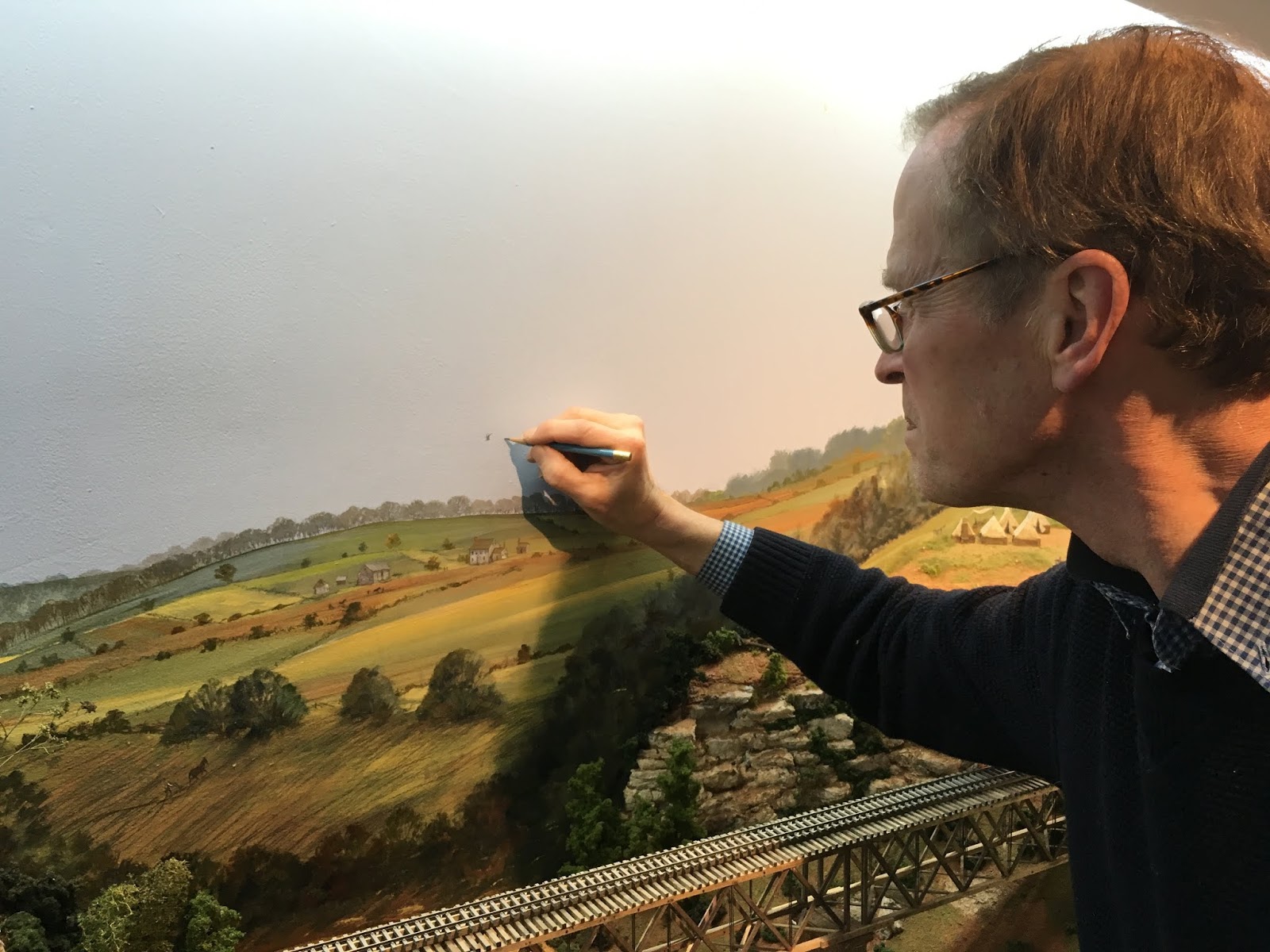
Brian, circa 2007, painting one of the three panel backdrops to Atlanta.
The crew who have made this layout what it is today. Each person is a master in their own craft, humbly speaking of course.
Myself, Brian from Connecticut, LeBron Matthews from Georgia, D.C. from Delaware and Christopher Eldridge from the Philadelphia area who built three iconic structures, the blockhouse, Lee and Gordon's Mills and the Barnsely Mansion and gardens.

Friday, December 6, 2013

Lee & Gordons Mills

Modeling Project by Christopher Eldridge

Lee & Gordon's Mills is one of the more known photographs by George Bernard who accompanied Sherman during the Atlanta Campaign. Located on Chickamauga Creek, the Union Army occupied this area just prior to and during the battle named for the Creek. Interestingly enough it is a Cherokee name supposedly meaning "River of Death". 
This being a famous structure of the area there were several photos taken, below are two. The clarity and variety of photos and its position along the creek made it an easy choice to include on the layout.


Constructing the Mill
Midway through construction in this photo, Christopher used Northeastern siding for the walls and being a master carpenter was very precise on measurements and, more so, the accuracy of the model. He began in October 2011.
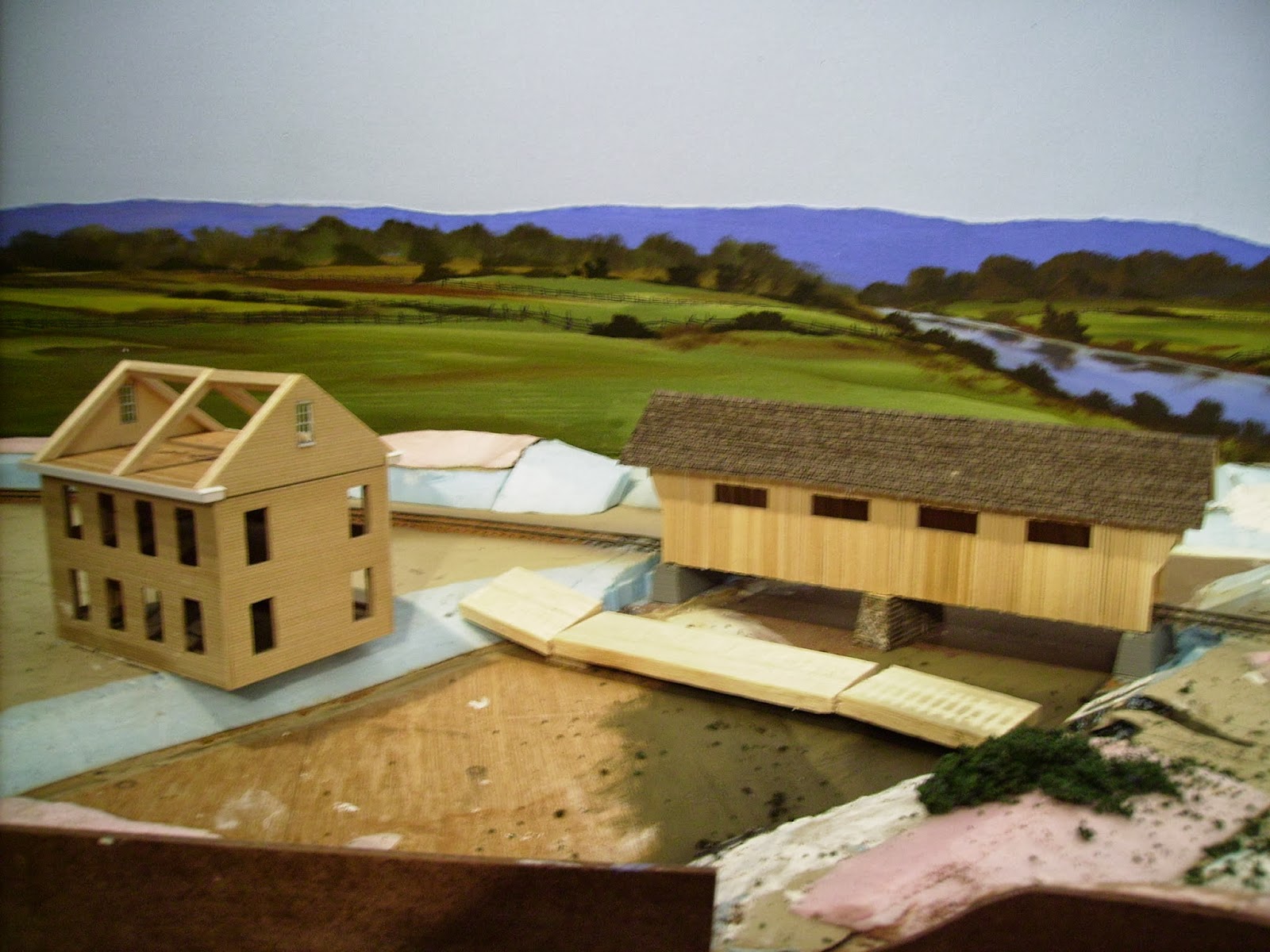
Chickamauga Creek has an east and west branch which converge into a main branch into the TN River. This main branch is simply known as North Chickamauga Creek. The mill resided on the west branch. Notably, the W&A traversed this creek approximately 12-13 times between Atlanta and Chattanooga. There is mention that covered bridges were common and although there was no such bridge near this mill, selective compression begs for the inclusion of one, hence, reasonable plausibility.
The balsa sections are the initial ideation for a wagon bridge that was actually there and nearly destroyed by Union cavalry. This crossing was a key ingredient for Gen'l Bragg and his Army of TN as they were attempting to close in for a battle with Army of the Cumberland. Here is the initial positioning of the Mill as the creek base is needing to be prepped for a pouring of Envirotex.

            Nearly a competed scene, landscaping and some structural details are to be added...
 
         A master at his best, true to form, he celebrates his progress and contribution. Nice slippers!


Sunday, October 9, 2011

Anniversary Crew Tributes


Crew Shots


November celebrates the 8th anniversary of the Western & Atlantic RR, North Branch. In 2003 Dick Taylor of RailDreams and one of his modeling associates installed the 25 modules that began the life of this model railroad. If you are new to this site, north branch simply differentiates my W&A version from the magnificent layout by Lebron Matthews. Living in Georgia, Lebron's W&A is referred to as the south branch.

I have been able to call on many modeling friends who have made significant contributions to the evolution of my layout. As a bit of a tribute I made an entry yesterday of the members from the Garden State Central model railroad club. Here are some of my other compadres along with a few appreciative comments.

Rhett's talent is super detailing 19th century locos. He converted a Mantua General into a USMRR loco when I planned to include Union operations. View his work by clicking on the Label - Locomotives. Brian is looking at pictures of Atlanta for ideas on painting the backdrop panels. D.C. is taking his 243rd photo, that day.
Brian Kammerrer, Rhett Tyler, the Supt' and D.C. Cebula
Another vintage photo, D.C. and Lebron enjoy a moment of "Train Running for the Confederacy". D.C. and I cut out a section of benchwork for closer access to the Kingston yard. Here he is running his first train using an NCE throttle. The train belongs to Lebron. We were experimenting with operations but mostly discovered a couple of shorts and low voltage areas. Although a little disappointing, we knew where to make the adjustments.
D.C. and Lebron Matthews
Jerry was the proprietor of Keyport Car and Foundry and was a source for link and pin couplers. He was also a wealth of information on early railroading and offered excellent ideas, along with some provocative perspectives, on modeling. Unfortunately Jerry passed away a couple of years ago. We honor his contribution with an Obelisk in the Kingston cemetery.
Jerry Daub with Lebron
An example of the crew refusing to work! They think working for 10 hours with no break is a little much. Light weights! Actually they're on a break, observing as someone engineers a train on a recently completed stretch of main line.
Lebron, Brian and Christopher Eldridge
My lovely wife Ku'uipo, Hawaiian, supplying the troops with beverage and vitals.
She has also made a few dozen super trees which now populate Kennesaw Mountain.
Vintage indeed, a 2007 scene of D.C. framing backdrops. This is behind Big Shanty.

Finally we have Christopher posing with his new slippers cutting a fine figure indeed.
 

Saturday, October 8, 2011


Garden State Central Members Visit for a  Work Session


Jimmy, George and Jules are pards from the Garden State Central Model RR Club. We have a web site as well which I encourage you to visit. I became a member around 2003. Everything I ever heard or read about the value of such membership is accurate.  Model RR clubs offer the opportunity to accelerate the learning curve and of course you meet some fantastic people, interesting ones as well.  

This is one of the evenings GSC members come by to work their magic. I try to get these fellas here as often as possible when I am home. Since the GSC has no home members visit one anothers' layouts to either work , run or do both. Here they have converged on Chattanooga to install leads to yard tracks and wire up switch machines. Needless to say having these mates is very much appreciated to expedite layout completion. Speaking of "interesting ones", in the photo above look closely at George. You can see by that mischievous gleam in his eyes he is definitely someone to watch out for. He too has a layout we visit for work and running sessions. Jules, in the red shirt, has been building a very cool garden layout. His website on the links is posted here.

To the left is Bob Judge, one of the founding members and patriarch of the GSC club. Bob is a master at various scenicing techniques and scene building. Here is using insulation foam for contours at the approach to Chattanooga. The backdrop is Lookout Mountain by Brian Kammerrer.


On the right is Butch. Also a member of GSC he excels at kit bashing and detailing rolling stock and structures. Here he is staining ties at the south end of Dalton in preparation for ground cover, real Georgia dirt acquired near Dalton. As we look to bring Dalton to life I'll be posting our progress.