Showing posts with label Ops Session. Show all posts

Sunday, August 17, 2025

Operating Session #17

August 12, Trainmen assembled into three crews of two operators each. Bill Myers was assigned to the special running out of Atlanta. A wide range of trains were dispatched, including artillery, mixed, cotton, and hospital. "Random Events" added the unexpected, a wreck train and a telegraph section. Operators also encountered a car with a broken axle, sabateour torching a bale of cotton, officers intervening and demanding two cars off fed and hay dropped on a siding. Bill's special was the spoiler as the other trains had no idea to expect him. Makes for a real-life prototype experience.

After each session, I ask everyone to supply me with highs and lows of their experience. During their runs, they also note where they had issues, e.g., derailments, short, poor loco performance, and anything I need to know for a smooth operation next time.

Here are a few pics from that Saturday...

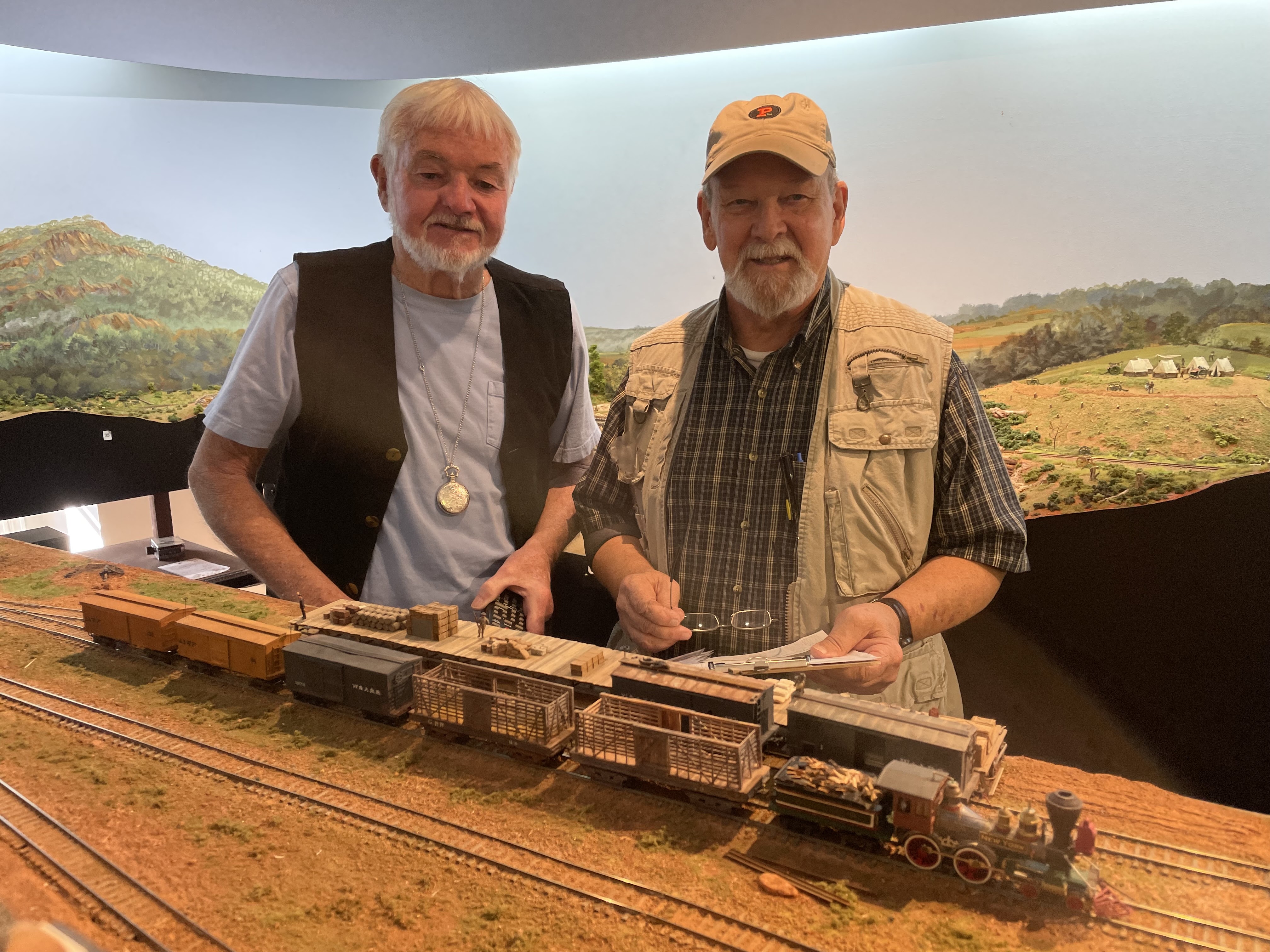
Corey and Roger are picking up platform cars of cotton in Kingston. Their Random Event was a torched cotton bale, and to uncouple that car.


Here we have Jim on the right, a first timer. He is the Superintendent for our sister NMRA Division, The Garden State. You can read about Jim,  layout updates, and the activities of their division in the Whistle Stop newsletter. Google the NMRA, Garden State Division and their website will pop up. He and Glyn are taking a train through Kingston, on its way to Chattanooga. 


Rob, the engineer, and conductor Dave are making a move in the north end of Big Shanty. Most of you probably know that the Great Locomotive Chase began nearby. By the way, this crew had the car with a broken axle. 


Monday, June 2, 2025

Operating May 31, 2025

We had our 16th op session here two days ago. If you have ever hosted an operating session, you are familiar with the preparation and setup required for a smooth, or relatively smooth, running of the trains. I begin with an email confirming the operators, date, timing, and other incidentals. One example is that we are an inside slipper or sock home; outside shoes are deposited on the inside porch. 

We have an orientation 15 minutes before the first run. I find this is critical to ensure operators are aware of operating nuances. A key one for me is the new hand-thrown switches using a push rod anchored on the fascia:

The rod is attached to the Tortoise switch machine. I plan to add more, as this was a manual railroad. It provides a more active role for the operator. One issue was that I did not allow operators to "practice" using the push rods. Consequently, I would hear the switch machine gears grinding because the operator was pushing and pulling too hard. I will now include a time to practice after a brief instruction.
Here is the Orientation sheet that continues to evolve:

timetable
I find that an orientation, even for operators who have been here a few times, helps anchor them into the time and era as well as new information and how the time table, etc, are to work. 

Below, the Yard Master is building a train with his yard engine, Alabama, for a crew's next run out of Chattanooga:


Switching maneuvers in Dalton with 
two crews negotiating the right-of-way. 
To the right, Dan is functioning as the conductor while a new operator, Andreas, takes position in the cab, figuratively speaking, of course.
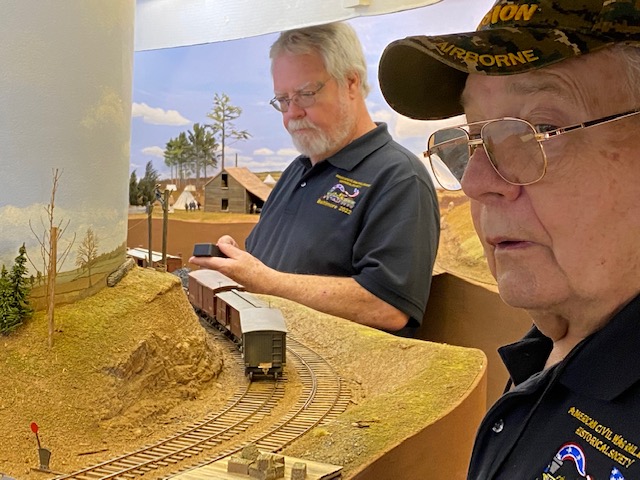
Above is a close-up of Dan and Andreas with loco Catoosa.


The first part of the operating session went flawlessly. However, after the first 45 minutes or so, one locomotive was not receiving power, and another had its motor turning but no movement. If the issue is not solvable in a couple of minutes, a replacement loco is acquired. The motor turning one had an issue with the shaft separating. Easy repair with CA super glue. She now became a backup.

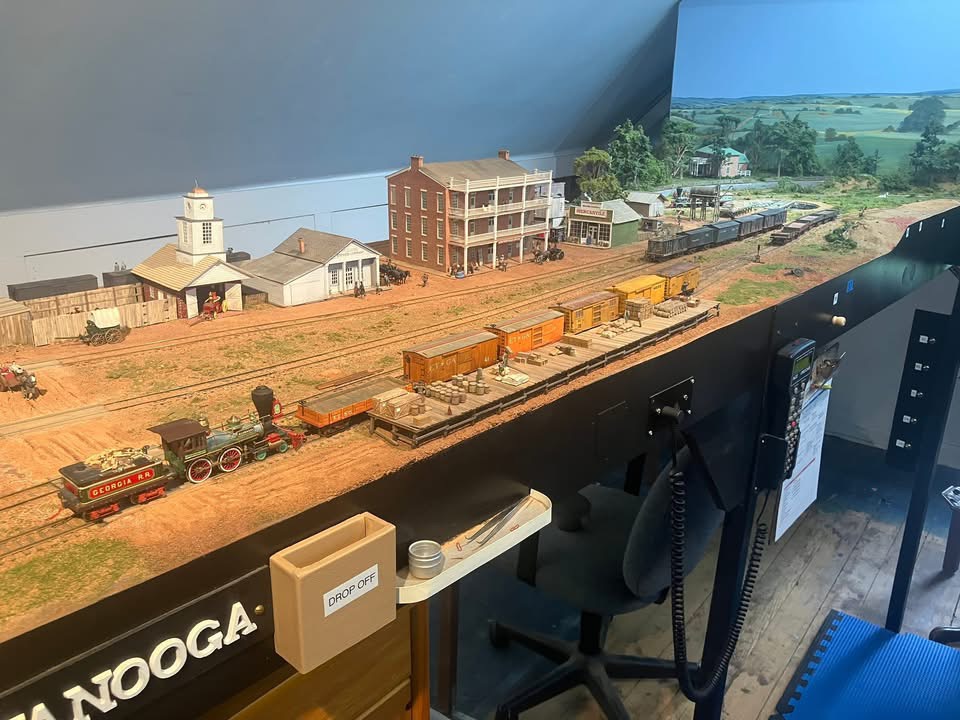
This is a pano looking over the south yard in Atlanta, over to Dalton:


And to give you a close-up view on how crews pin the link, as we say, here is a photo by Jim Judge, YM for Chattanooga, showing how it's done. I have found tweezers with LED lights, which help immensely in a dark area of the railroad.


I ask crews to be sure to make notes on their Time Table sheets with any issues, including track repair, car breakdown, and areas where they experienced a short; also to note the actual arrival and departure times. These notes allow me to fix the issues before the next ops.
Bottom line, they continue to come back and enjoy operating and hanging with friends.


Wednesday, May 29, 2024

Lessons Applied from May Ops

During the May ops, operators were forthcoming with two excellent suggestions. One was to add two throttle fascia panels to conduct their operating. One was added to Tunnel Hill. This allowed for ease of access as it can be a tight area for 2-3 crews. The other was in Atlanta. This one will provide access to running into and out from the roundhouse. 

The craziness to install Atlanta...

Laying new cable...

But AFTER a whole lotta stuff needed to be moved...


May Operating Session

Our latest and perhaps one of our most enjoyable train runnin sessions.

Left to right, Andy, Heath, DC, Ted, Rob and Jim. Unfortunately Corey had to leave early.

When planning these sessions, there are always one or two operators that may need to cancel last minute. I lost my mind as I had spent more than a week working out the schedules for two member crews. Another lesson learned... KEEP MY COOL! It worked out great. There were four trains and two had solo operators. This helped me realize that one person can do all the jobs. Now I just need to make a few adjustments to minimize all the paraphernalia an operator needs to carry. Easy! 

This view shows the new ops elements I incorporated into different train orders. The car with derrick is the wreck train with two attached cars. These were mentioned in a couple of writings by trainmen who rode the W&A at the time and other lines such as the VA Central, East TN & GA and GA RR.

Bottom left is a telegraph car. This would take new poles and insulators to set along the line or to replace those needed.

The keg is one of whiskey which seemed appropriate to "support" the troops. Next is a grease bucket, the idea coming from Wilber Kurtz notes that one engineer was asked to meet another train to hand of a bucket of grease. 

Last are pole cars. Lever cars were had not arrived on the W&A in 1863. However, these pole cars were on occasion transported to an area where workers would need to travel down a line to either inspect of conduct minor repairs. 

During this session, each of these were added to a crew's train orders. The feedback was ecstatic as it provided a hands-on experience for the operators.


Monday, January 29, 2024

OP Session January 28, 2024

Another fun ride on the W&A, north branch! Operators included members from our ACW RRs group, Corey, Bill and DC, https://groups.io/g/CivilWarRailRoads. Another person, Glyn is a fellow board member in our NMRA Division, and Ed who is a member from our local model RR club, Garden State Central http://www.gardenstatecentral.com/

I had three train schedules prepared. However, a couple of folks couldn't make it last minute  And, I didnt even think about removing the one train. This, however, made for an interesting movement for the crew that encountered this train as it blocked their route. 

One of the compelling aspects of modeling this era is the consistent randomness of situations which were very prototypical then given the demands for both civilian and military needs and requirements.

Below, Bill is Yardmaster in Chattanooga while Ed and Glynn are preparing to depart for points south.


DC, brakeman, and Corey throttling through the Kennesaw Cut with a mixed freight of empties pulled by the W&A 4-4-0 Georgia. All names for the locomotives, as well as businesses and particular land features are consistent with the W&A line in 1863. 

Glynn and Ed taking out the Catoosa for its first run of the day, also a mixed freight with a few passenger stops scheduled along the way.


Saturday, November 26, 2022

Operations 11.12.2022

For many model railroaders, running trains in a similar fashion to how they operated in real life is an objective to building a layout. Prototype, prototype freelance or freelance, makes no difference. I worked with period information on way bills and schedules to create an experience for friends to visit and work in crews of two. 

Here's the crews from Nov 12...


Dave and Ed changing out cars in Kingston. Dave and I go back to high school. Ed is a member of our local Garden State Central Model RR club in Wall NJ.

Dan and Bill are picking up empties from Camp McDonald at Big Shanty. Both are members of our American Civil War RR's Historical Society. Historians to modelers participate in our monthly zoom meets.
Success!
Aside from the occasional, and in many cases prototypical mishaps and breakdowns, there were issues with derailments and decoder learning. Derailments were found at one turnout which has been rectified. But this is something that does occur. It's 1863. Trackage was rough to begin with. The key is not doing anything about the mishap and excusing oneself with "well, that's prototype". Repairs and fixes are part of the equation.    


Ed and Dave come to the end of their run. Truly, a good time was had by all.


Friday, October 14, 2022

Annual Civil War RR's Meet in Baltimore

We are known as the American Civil War Rail Roads Historical Society, created in 2003. For many years we would rendezvous at a location with ACW RR history. We've been to City Point, Chattanooga, Atlanta, Memphis (2x), Alexandria, Savannah, Harper's Ferry, Gettysburg, Hanover, now Baltimore, for a second time. Prior Baltimore trip was 2012. The trip covers about 3 days, Thursday evening through Sunday morning. Typical trips include site visits, clinics, speaker(s) and ideally operations sessions at a local model railroad. Here are some photos of our trip. Hope you enjoy the ride...

This was at the B&O museum in Ellicott (pronounced Elikit) City. Our guide was incredibly knowledgeable. Being of Irish decent, he was very familiar with the B&O as one of his ancestors was a railman. 

Left to right, Charlie Taylor who models the M&C, O scale, and lives in Tennessee. DC Cebula, living in Delaware, models an HO freelance layout, the Del Central. The back of John Bopp who models in HO scale and is an historian of locomotives.


Here we all are in front of the William Mason 4-4-0 in the B&O RR Museum Roundhouse. This loco was leased by Disney for the Great Locomotive Chase and used as the Texas. Jeffrey Hunter, Slim Pickens and other actors rode this baby! 

Left to right, Charlie, Ken Bruns, Paul Ciesmelewski, DC, myself, John Bopp, David Bjorkman, Phil Ruehl and Marty Vaughn. 

I was able to get a peek into the cab. Later found out that this is verboten! 

Here we are at Bernie Kempinski's O scale USMRR Aquia Line participating in an operations session that Bernie had arranged for us. This is the highlight for many of us!

Until next time... Happy Rails!


Tuesday, February 25, 2020

FEB 2020 OPS SESSION / SHAKEDOWN & PEACHTREE ST RENOVATION VIDEO

It's what can happen when my honey decides to go visit one of her friends for more than 4 days... INVITE THE CREW! In addition to DC and Andy, a very good friend and contributor was able to visit as well, LeBron Matthews. One day we will feature his remarkable modeling as he too models the W&A, referenced as the south branch. LeBron is from Columbus Georgia.


This crew was here on Wednesday working on different projects as well as to help prep for the Thursday night ops session. DC continues to scenic the new section. More on this section and DC's work in a future post.

 LeBron scenicing Atlanta; grass was more likely in many areas around the tracks and yard than I considered. Where there is no traffic most likely there'd be grasses. Needless to say, the added greenery has a few effects. 1) it pulls the elements of Atlanta together, the green is the connector to the structures. 2) it fills out the area of Atlanta; makes it "pop" as some like to say.
3) the color adds a pleasing invitation to the eye.

Andy took on his first structure, a Woodlands Scenics casting of the Tack Shed. The door off the hinge was his intention!
Six other fellas came by for the session. Adding LeBron and Paul, we grouped them into four 2-man crews, one engineer and one brakeman. In addition to operating the loco, the engineer handled the way bill/schedule. Brakeman had responsibility for coupling, switching. Here Lebron, engineer, along with his brakeman Paul, maneuver the Dr. Thompson consist into Big Shanty. DC and I were trouble shooters.

Engineers and Brakemen
Left to right, LeBron, DC, Ray, Paul, Bill, TR, Dave, Hilmar, Ed and Andy. Paul, Ed and Hilmar are from our local RR club, Garden State Central. Paul is building an HO scale W&A layout, focusing on the Battle of Mission Ridge. Ray has a MASSIVE HO multi-level layout, Norfolk and Western. Bill and Dave contribute to his layout and all three are members of the Model RR Club. Andy is our resident photographer and videographer. He excels at tree making ,and during this visit apprenticed with LeBron on scenic work.
Lessons learned or reinforced
1) Prior to ops session, have a friend review the schedule/way bills. We found out, 30 minutes prior to people arriving, the schedules included the same cars! During staging this was most apparent as one person set up a consist, went off to do another, only to return and find the cars he set gone!  
2) Always invite guests to offer feedback. Most often they will not offer input to avoid offending. This also shows them that your intention is to improve the efficiency and fun. 
3) Just because a person has done the brakeman job a few times does NOT mean they know how to engineer a locomotive! Although we are familiar with shorts, we had an excessive number this time. Speaking with one engineer at the end, I realized this engineer did not know that he could not run a loco into an adjacent turnout if the rails were not aligned to the track he was exiting! Good news is that this one breakdown indicated that we did not have a massive, layout wide, short issue to untangle.
4) Coupled with number 3, invite operators who are familiar operating on your layout. Then be sure to partner the most familiar with newest guests.
5) The realization that metal wheels can cause a short when the stub rails are either too close or wheel sets are too loose and hitting both rails simultaneously.


Sunday, June 16, 2019

West Coast Visitors

This past Thursday we had the great pleasure and honor to host two friends from California. Mark Richardson is a member of our ACWRR Historical Society and has attended several of our annual meets. He is well versed in the miniature military modeling including N scale ACWRR T-Trak modules, HO rolling stock and currently he is building a 1/130 scale aircraft carrier! Man of many talents, Mark is also a Civil War Re-enactor. He was on an east coast trip with his friend Rick who had two speaking engagements, one out near Valley Forge and the other in Albany. Rick's topic is based on his book of a NY Volunteer regimental history. Being this far east, Mark asked for a visit and if we could accommodate an operating session. A few of my reliable friends came with short notice. If you been here before you have seen Martin, Dave and Jimmy.
Left to right... Dave, Jimmy, Martin, Rick and Mark!


Thursday, February 28, 2019

Operations Session

February 21 the W&A hosted its first official ops session! Long time coming it has been. We were honored to have six friends partner up in crews of two, one engineer with a brakeman. 7:00 PM crew members arrived to orient themselves to their schedules and plan their ways of working. 7:30 the clock started and everyone was completed by 9:15. Of course there were many breakdowns that were communicated to the superintendent, providing LOTS of maintenance work orders. But this is to be expected, although he (I) was more disappointed than expected. Bottom line is that it appeared all had a fabulous time.  
Engineers were responsible for operating the locos. Brakemen had responsibilities for coupling, re-railing cars when necessary and ensuring switches were set accurately. 
The schedules were challenging in that the timing of arrivals caused negotiations in order to ensure that their respective time tables were successfully met. 
The image below, with a Yankee who somehow infiltrated as a brakeman, shows Paul with Jimmy at the throttle. Shortly after this shot, another consist came barreling through with DC at the throttle causing one of those "challenging" situations. However, when considering this is 1863, trains were constantly running at all times in order to meet both military and civilian demands. Hence, this was quite prototypical. However, schedule adjustments will be made for the next session.
This next photo has brakeman Christopher questioning engineer Martin's instructions on how best to build their consist in Chattanooga. Martin is a veteran engineer and Christopher... well, this was his first time in this role. He had a steep learning curve, and did quite well.
Below, my good friend from high school and college, Dave Eberhardt, is on his maiden run as a first time brakeman with DC at the throttle. Dave had a layout in the '70's, my first experience helping to build structures and learn a few basics. Here they are building their consist in Atlanta. 
This one below is the opening of the session, two crews setting up their respective runs.
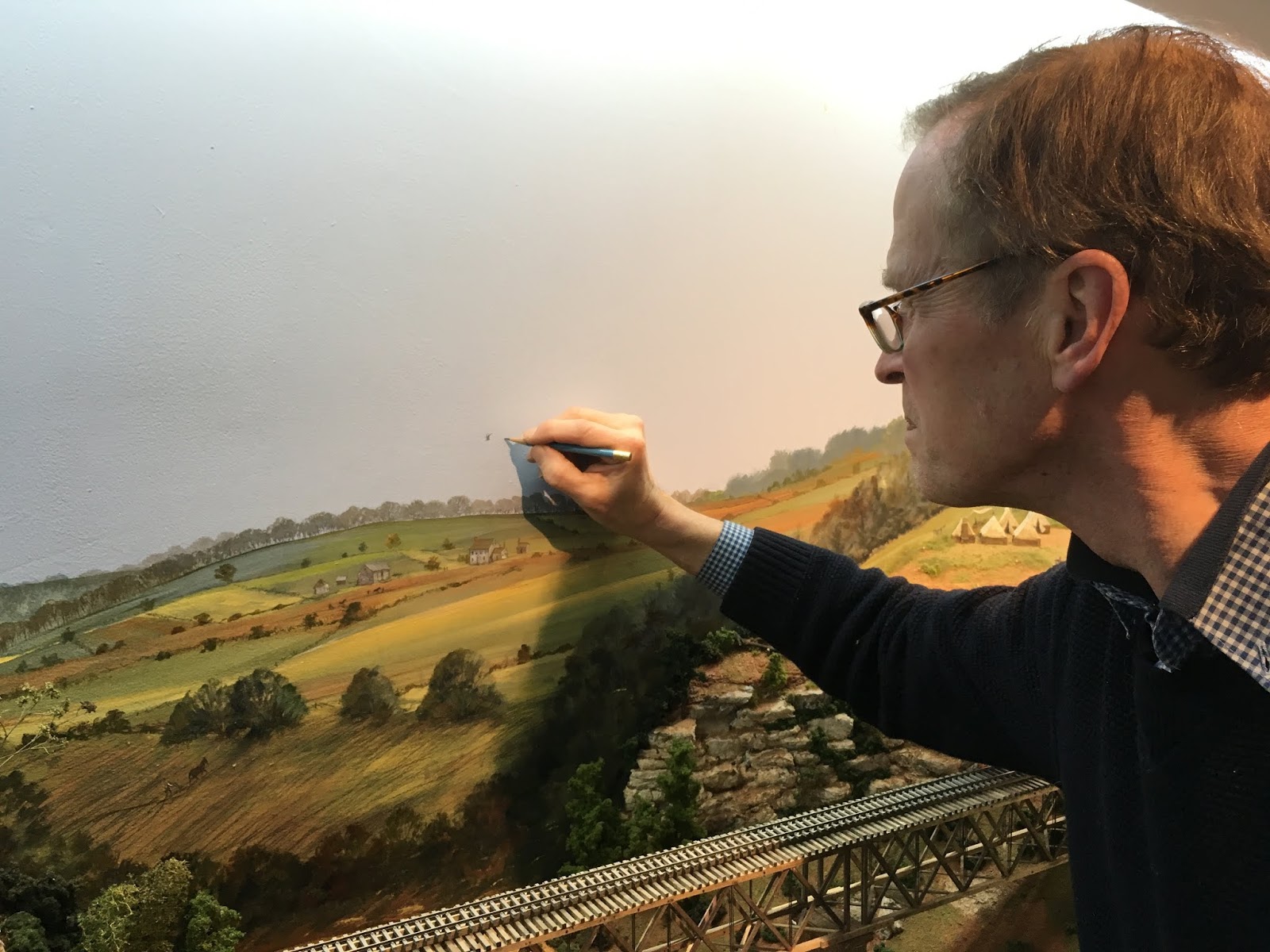
Prior to this evening, one of our favorite modelers and friends, Brian Kammerer visited. It had been quite some time since his last appearance. He did not like a bird I had set into the backdrop because of the shadow. So in his nature for clean imaging, we were able to get him to add a small flock of crows to the backdrop, the latter which he had painted in the early days of layout construction. So good it was to have his rare visit to the W&A. Here is a link to his art work http://www.cwbattlemapart.com 
DC arrived early to complete his scratch build of a prototype fire house in Chattanooga. "Look what I did!" And it is ridiculously exquisite! 
Shorty after, he wanted to see the cars he had built for his own future layout run on our W&A. All was well until he begin to uncouple. He pulled the pins, however, the links were a bit tight in the coupler pockets. As he pulled one car off it pulled the next... HO dominoes resulted! Although there were a couple of casualties, they were easily repaired. Lesson-do NOT uncouple on elevations!
This ops event was a much welcomed achievement given we've been at this since 2003! Using the hindsight factor, I would have ... but hindsight also says there is only so much planning; best is to get into it and be open to learn, adjust and have great friends to share the joy along the way.