Showing posts with label Trackwork. Show all posts

Tuesday, December 17, 2024

NICK KANE"S SACRAMENTO VALLEY RR, Part 1

Nick is a true artisan. His skills and talent is second to none! Nick is an Antique Restorer specializing in many fields from Tin Lithograph  sign restorations to stoneware and 19th century Furniture. Over the last few years he has and is applying his creative talents to model railroading. 
He is building and HO scale layout of the Sacramento Valley RR, circa 1856-65. You can watch a conversation between he and I on my YouTube Turntable Discussions.
There will be a series of posts here that will include his layout build such as structure builds and scratch built brass 4-4-0 . CRAZY!

This is a Sanborn map which he has referenced for his layout as an overview for his rail road. 

Here is one of the period photos Nick has been investigating to match the map with actual track and structure placement...

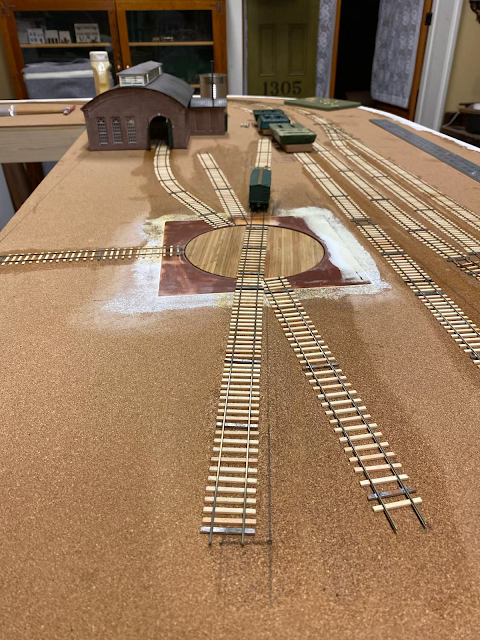
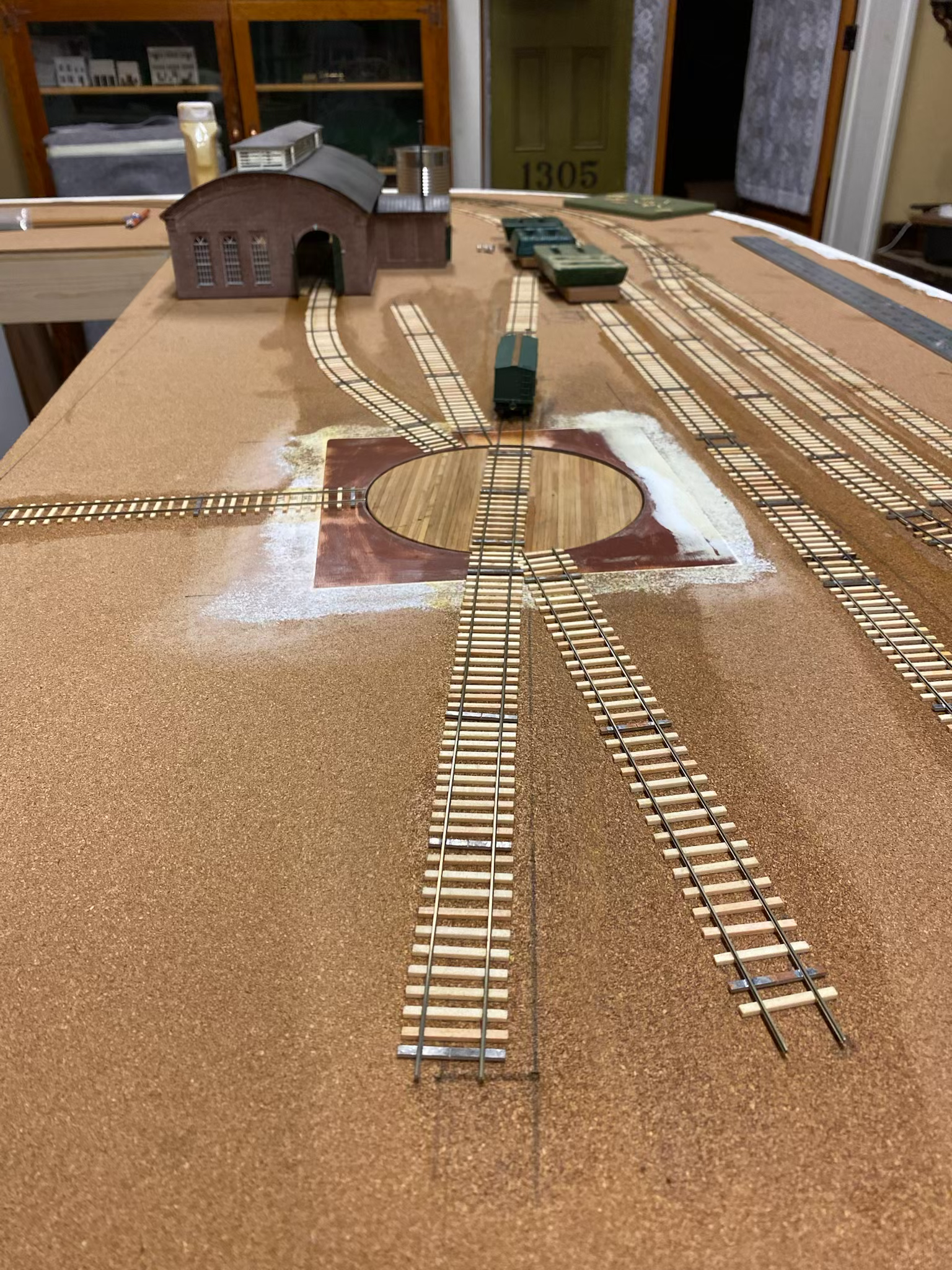
The following photos reflect the track work around the turntable.


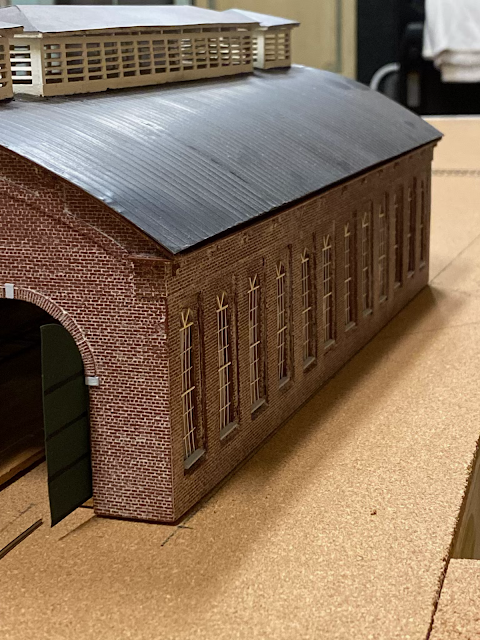
The engine house was also scratch built... of course.

Stay tuned for more to come, e.g., his 3-way and switch builds using Fast Tracks and his magnificent loco build of the L. L. Robinson!


Thursday, March 24, 2022

Workin on the DC - Delaware Central RR

 This past Tuesday I took a ride to Newark DE to see our good friend DC Cebula and his progress on his period layout. WOW has been motorin! Prior to making this photo happen, he began last year preparing the layout room in his basement. Herculean effort it was. Now his benchwork is completed and track is being set in preparation for permanent bedding.


To our right, your left, is a return loop. His is building a freelance prototype of the DE Central RR. All of his 30 plus turnouts have been built with Fast Tracks templates. One remarkable attribute of DC is his meticulous attention to all construction, from benchwork to track work, etc. During my time with him, as I have made two trips in two weeks, we have built the laser cut throw devices and placed the track exactly where it will be permanently adhered. Visit his website, https://delawarecentralrailroad.blogspot.com/

Although he has not uploaded layout photos yet, you will see his magnificent modeling skills.

Monday, April 27, 2020

Member's Bin Busy!

Over the last several weeks, as we have been honoring the "stay home" recommendations, I have been hearing from several friends and members about their respective projects. This post is to give y'all an idea on what folks are doing, from masters to beginners. There are four, most of whom you have seen before. First up, Charlie Taylor's M&C, Memphis and Charleston. He is currently further detailing the area in and around Memphis. Charlie is one of us 'crazy' modelers. In addition to hand carving tunnel entryways as limestone block, Charlie just finished carving this cobblestone street. 
This is the area planned for the cobblestones, around the M&C Depot. 
He uses a sheet of bass wood for carving the stones.

And here are two photos with final results...

Next we have a relatively new modeler, Paul Ciesmelewski. I met Paul through a local hobby shop, Hobby Masters, which unfortunately is no longer. However, Paul is one of those other rare modelers focusing on civil war and coincidentally, the Western & Atlantic. He has already scratch built the Chattanooga Car Shed and a church. His next project is the premier hotel of this dirt water town, at the time, the Crutchfield House. It was located within a short walking distance from the shed, or passenger depot. 
He has a unique approach in that he is building the shell to be able to be removed from the interior structure. 

Paul is dividing the interior into three floors and about 16 rooms. 
Main structure complete, he is adding this roof. Eventually Paul plans to add basic interiors, wall paper and home made furniture items. His 'crazy', however,... adding lights to the fireplaces! His layout will also depict the battle of Mission or Missionary Ridge in 1863. 
Someone known to most ACWRRHS members and perhaps in the model railroad community, LeBron Mathews, is DE-constructing his W&A with a reno plan to allow more options to run his railroad, operations and, as important given his inventory, storage. As he has begun to remove structures and dismantle track, to counter balance the remorse of tear-down he is also upgrading structures with finer details, if you can imagine that for LeBron. The LOC (library of Congress) is his primary source. 
Most of LeBron's work is scratch building. One example of his upgrading is the Atlanta Hotel. A photo prior to the changes below.
His rebuild shows a completely different roof trim, sign with yellow trim, balcony spindles removed for a solid wall and red shutters. What other changes can you see?
How does he know this? There are a couple of sources. One is the LOC where TIFF files reveal slight variations of color as well as details otherwise undetected. Second source is information about structure building at that time. As an example, two primary colors were used for trim and shudders. Generally speaking, green was primarily used on residential and small businesses. Red would be found on the more high end establishments such as the Atlanta Hotel, one of a few in Atlanta.

In addition to his scratch building, LeBron also uses kits. One of the most similar looking period structures is made my DPM, Design Preservation Models. Here he changed out the roof from flat to tin.
His coloring and weathering is off the charts! George Selios would be proud!
Next up is the Delaware Central RR. Our good friend, and co-founder of the American Civil War RR Historical Society, DC Cebula is beginning his foray building a layout. After MUCH re-configuring... no not the layout plan although that is always a process, he is revamping his basement first! Already with new lighting, outlets, relocating his "stuff" and having purchased lumber, here is his latest track plan. Grids are 1' so this will be a 4'x12', however I believe he mentioned he is working to extend it to 18' . The red line is the backdrop, narrow side for staging. However, please do take a ride to and into his new BLOG! 

One fella you may have heard about in one conversation of another as only a few of us know is Rhett Tyler. He certainly has the right name for our era. Rhett has been nt only modeling but has built some of thee most detailed accurate models of locomotives. He did one for me based on a photo from Chattanooga, #50, a USMRR 4-4-0. That was when I was planning to have Union forces in Chattanooga and Confederate in Atlanta. However, after he built this gorgeous model I soon after dropped the Union idea. It is now being reconfigured as the Tennessee, a Georgia RR loco. Check out the piping and the prototypical cross head guide. 
Decals are compliments to John Ott, another master who we quite honored to have in our midst and joined us for the Gettysburg meet in 2015.

Rhett is modeling the New York Central & Hudson River RR. His bridge is scratch built. And these are just a few of his collection of locomotives. I believe he has close to 14. His knowledge of locomotives is extraordinary as well as rolling stock of the era. I have called him on many occasions when uncertain about a design element when doing my own rebuilds.

As you can see, and perhaps you as well, we are channeling our energies that can uplift us when the news can be quite disturbing. In one way we intend that these posts and photos will be a contribution to you, as an inspiration or at very least an enjoyable read. Very Best! 

Tuesday, February 25, 2020

FEB 2020 OPS SESSION / SHAKEDOWN & PEACHTREE ST RENOVATION VIDEO

It's what can happen when my honey decides to go visit one of her friends for more than 4 days... INVITE THE CREW! In addition to DC and Andy, a very good friend and contributor was able to visit as well, LeBron Matthews. One day we will feature his remarkable modeling as he too models the W&A, referenced as the south branch. LeBron is from Columbus Georgia.


This crew was here on Wednesday working on different projects as well as to help prep for the Thursday night ops session. DC continues to scenic the new section. More on this section and DC's work in a future post.

 LeBron scenicing Atlanta; grass was more likely in many areas around the tracks and yard than I considered. Where there is no traffic most likely there'd be grasses. Needless to say, the added greenery has a few effects. 1) it pulls the elements of Atlanta together, the green is the connector to the structures. 2) it fills out the area of Atlanta; makes it "pop" as some like to say.
3) the color adds a pleasing invitation to the eye.

Andy took on his first structure, a Woodlands Scenics casting of the Tack Shed. The door off the hinge was his intention!
Six other fellas came by for the session. Adding LeBron and Paul, we grouped them into four 2-man crews, one engineer and one brakeman. In addition to operating the loco, the engineer handled the way bill/schedule. Brakeman had responsibility for coupling, switching. Here Lebron, engineer, along with his brakeman Paul, maneuver the Dr. Thompson consist into Big Shanty. DC and I were trouble shooters.

Engineers and Brakemen
Left to right, LeBron, DC, Ray, Paul, Bill, TR, Dave, Hilmar, Ed and Andy. Paul, Ed and Hilmar are from our local RR club, Garden State Central. Paul is building an HO scale W&A layout, focusing on the Battle of Mission Ridge. Ray has a MASSIVE HO multi-level layout, Norfolk and Western. Bill and Dave contribute to his layout and all three are members of the Model RR Club. Andy is our resident photographer and videographer. He excels at tree making ,and during this visit apprenticed with LeBron on scenic work.
Lessons learned or reinforced
1) Prior to ops session, have a friend review the schedule/way bills. We found out, 30 minutes prior to people arriving, the schedules included the same cars! During staging this was most apparent as one person set up a consist, went off to do another, only to return and find the cars he set gone!  
2) Always invite guests to offer feedback. Most often they will not offer input to avoid offending. This also shows them that your intention is to improve the efficiency and fun. 
3) Just because a person has done the brakeman job a few times does NOT mean they know how to engineer a locomotive! Although we are familiar with shorts, we had an excessive number this time. Speaking with one engineer at the end, I realized this engineer did not know that he could not run a loco into an adjacent turnout if the rails were not aligned to the track he was exiting! Good news is that this one breakdown indicated that we did not have a massive, layout wide, short issue to untangle.
4) Coupled with number 3, invite operators who are familiar operating on your layout. Then be sure to partner the most familiar with newest guests.
5) The realization that metal wheels can cause a short when the stub rails are either too close or wheel sets are too loose and hitting both rails simultaneously.


NEW TRACK WORK & STUBS

Since the layout expansion I have been quite busy laying new track including 4 stub turnouts, one being a 3-way. The latter is quite the challenge in finding a workable solution for switching the single fly rails as the typical machine throws one way or the other. Mike Prokop of our NMRA Division suggested, and confirmed by my good friend Ray Russel, that a "servo" is the way to go. Of course I have NO idea what that is or means. However, with the 2-way stubs I am most familiar. 
I use assembled stubs by BK Enterprises, known today as Trout Creek. Although you can ask for a #4, 6, etc., they typically come with longer rails than needed; they are also adjustable given the frog size you may require.
These come with metal plates that hold the switch together. You need to unsolder the plates, then align, gauge then spike the rails. 
Simply apply your hot iron and separate the rails. There is an advantage to having the turnout nearly cut to size, most so the frog. My track, however, required modifications of these by either adjusting length and curve  to meet the already laid track, and then of course ensuring gauge and flange gaps were accurate...

In all, two curved, one straight and one 3-way were installed. Unknowingly, I used #4 templates thinking that's what I needed. However these were too acute. I used closer to #6. 

Above photo also shows the initial positioning of the 3-way. Ray fortunately laid the ties using a jig. I simply spiked the rails. However, I had NOT considered the foundry being a visual impediment to the stub; therefore I needed to move the stub!


 I made a variety of cuts and end shapes for the ties. Photos of the times show everything from milled to roughly hewn, different lengths and naturally weathered since there was no creosote then.

Tuesday, December 3, 2013

Chattanooga Progress, posted Dec 10, 2014

Here are the latest photos of progress in Chattanooga. Our last posting of this section showed only a few mock ups and maps.
Below you see the addition of the Adams Express CO. and the Crutchfield House, the nearby hotel to the car shed, shown here as the white mock up in the background. 
DC added the platform. Although the platform is not shown in any diagrams that we've researched, nor is such a structure mentioned in any reading, for the purpose of a model railroad we included it for operations.
This photo is looking south, opposite from the above shot. We are 90% complete on this section. Other details and perhaps another commercial structure could be added in the open space at left.
Chattanooga was a terminus for the W&A and Nashville and Chattanooga lines. Later the East Tennessee and Georgia RR was added. The Memphis and Charleston passed through Chattanooga. Given that all these lines came into Chattanooga there are many possibilities for model railroading operations. 
The yard was filled with cars from different lines for the sake of the photo. These other rail lines are the Atlanta and West Point, Macon and Western and Georgia RR, all of which came into Atlanta.
These last two photos below show the scratch built Adams Express Co. and Crutchfield House, built by Chris Comport.


Consolidated

As with most model railroads a key element is selective compression. Here is a map, from our late contributor Zoe who was constructing a virtual W&A of the period, showing the rails into Chattanooga. There are two distinct features. One is the 2 tracks entering what is known as the Car Shed or passenger station. The other is the Wye track formation used to reverse locomotives. There was also a turntable in Chattanooga which appears in the next illustration below.


This drawing below showing the turntable is from a book entitled The Union Railyards Site, Industrial Archeology in Chattanooga, Tennessee by R.B. Council and Nicholas Honercamp. It was attached to the center track between the Car Shed and the other rectangular structure, the W&A Freight Depot, to its right. According to the authors, this is "The Federal plan of Chattanooga, 1863" and was from F.W. Dorr's 'Chattanooga and Its Approaches,' drawn after the battle of Chattanooga in November 1863. I chose to include the turntable, not the Wye since my space was too limiting.
Right and center is a notation, Battery Hazen, and was also know as Stone Fort. We have a tentative plan to include a portion of this fort at the layout edge.
Below is a photo taken from the area in the foreground known as the Stone Fort. So far there are no other details about this feature making it a creative endeavor for the layout. There is also mention of a Judge Hooke's residence in this view. Although barely visible, it was located in the grove of trees in the left background. This structure is being scratch built by D. C. Cebula. 

There are many interesting buildings to be considered. I chose prominent ones including a hotel known as the Crutchfield House, the Adams Express building and the home owned by Judge Hooke. Here is D.C.'s version as an HO structure, emphatically informing me that "...the chimneys are going right there!", as we debated the location given the photo. You decide and let him know... PLEASE.

These two photos of Hooke's residence were taken post war an deduced that the enclosed balcony was post war as well. As D.C. has completed the basic structure, next are the detailed elements and landscaping. One anecdote is that when Chattanooga residents were evacuating, the Judge was provided with his own house car to remove his personal belongings.


For the Car Shed I connected with Alkem Scale Models, http://www.alkemscalemodels.com (Bernie Kempinski) to laser cut and construct the building primarily for the exactitude given the numerous arches and trusses. 
Here is a period photo followed by Charlie Taylor's model. He is building the Memphis & Charleston R.R. in O scale. Here is a link to his site, jcharlestaylor.com/taylorSPECIALtrains.


The Crutchfield House in mock up...

This will be scratch built by Christopher who has also done the Lee and Gordon's Mill and the Barnsley Garden Mansion. Both are featured in previous blog posts and in our Labels section.
Here is a long view to compare with the 2 maps at top of page... Photo is taken from the Wye area and the Stone Fort site.

Adams Express is in the early stage of mock up. It was situated between the Shed and Crutchfield House. Here's about a 20x, zoom from a period picture: