Showing posts with label Trees. Show all posts

Tuesday, September 6, 2022

Flat Figures by Brian Kammerer

Many, many months ago, I needed to scenic the area that increased in size as a result of opening up the aisle just south of Kennesaw Mtn. This area is at the top left corner between Kennesaw and where "Mill" is noted. The entire table of the Atlanta area is now parallel with the back wall and allows for a pleasurable 3' aisle.

I now had 3' feet of new real estate to scenic which I found artistically challenging and was a good thing. I had several ideas including a small farm, dirt road, double post and rail fencing. Mock up  structures were placed in the area. However, it all felt too busy.  Trains would be passing the Redoubt which has perspectives then a farm then mountain... So I just sat and pondered gazing into the bare benchtop. I would come back over a period of about 4-5 months. Interesting how the idea finally lands. I decided that I would create a deep perspective with distance. The backdrop / ridge line is foam core with a couple of layers of flocking. I would  need to show a 1000 yard or more distance from the ridge line to a full size (HO) foreground. 

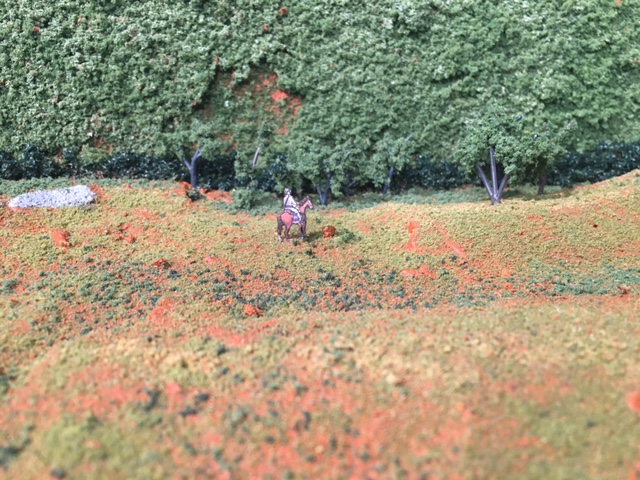
This photo below shows the first steps to bridging the distance. At the base of the ridge line is a dark tree line. The intent is to show a tree line closer to the viewer and enhance the perspective experience. There are two figures in the middle ground. This is what I call "concept measuring" to ascertain plausibility for the entire scene. The cluster of trees is meant to be a view-through element. Once painted and flocked, I want the viewer to peer through the trees to help distribute the perspective as they see the scouts. The stream, and of course the house car, are the foreground. The fun of creating this scenic element is assessing what to place between the stream and the ridge line to foster the sense of distance.


Close up of the above photo...


Even closer image below. The figure is another Brian Kammerer creation. His film "The Other Great Locomotive Chase" is populated with a plethora of flats. When I mentioned to him what I was doing he suggested flats. I had hoped he would. He graciously created a few sheets of infantry, cavalry and artillery figures. Everyone who has viewed this scene could not tell the scouts were flat.

One of the figure sheets Brain created is below. All I did was reduce the size then print a sheet. After cutting the figures I wanted, and adding a thin sheet of cardboard backing for rigidity, I simply glued a straight pin to the back. The bench is blue insulation foam, making installment of the figures very easy.  


I am getting ahead of my process.

While still in the imagination phase, and driving around on different days, one day as I was passing a field. I saw exactly what I was wanting to build. In the middle distance from the road there was a cluster of trees. The added component missing in my scene was the vegetation among these trees. Small, wild growing shrubs, bushes and some vines. Here is the nearly final touch, close up...


A more distant view...

I want to add more underbrush among the trees and in the open field. However, for the most part, I am quite satisfied with the results.

Sunday, March 10, 2013

Kingston to Dalton and Beyond

A recent visit this March by friends who have been contributing to the construction of the Western and Atlantic RR for many years, DC Cebula, Brain Kammerrer, Christopher Eldridge and Andy Salcius, have moved us toward the last phase on this layout. 10 years in the making, Andy, aka Uriah Stephens, shot this "creative" video with a few sound effects, unlikely heard in any steam locomotive sound decoder.
 

The following photos attribute the recent work projects with their respective authors. I use this term author deliberately since the skills that each person brings is at a level where I trust their ability to "author" their sense of a scene or scene element. 

 LeBron, on his January 2013 visit, has painted, inserted and here is dry brushing the perimeter fence (Musket Miniatures) of the Barnsley Estate. Godfrey Barnsley, if you missed prior postings, was a cotton trader. With offices in Atlanta, New Orleans, Savannah and London, interestingly he was opposed to slavery and paid all his workers.
He was also known for his extraordinary gardens, some of which we plan for the center section just in front of his home. This mansion was scratch built by Christopher from book illustrations in Barnsley Gardens. You can see Chris' work under LABELS for Barnsley.


Sunday, September 30, 2012

A New Modeler

I have known Andy for about 15 years., mostly through his cello music and improvisational gatherings. He has been integral to helping me establish this blog. He also takes great photos. However he had never done any modeling. A few months ago he took on making trees, with a little coaxing, as a first. As you may know, trees are always a scenic feature, especially those in foregrounds. A simple technique I use Andy is demonstrating here with medium and large plastic trees by Scenic Express. First step is to cut the plastic pin molded onto the tree base. The intent is to insert a brad for easy replanting. Once the tip is removed a hole is drilled into the base the size of the brad, and about 1/8" to 1/4" deep. There is usually plastic residue on the bit and is easily removed by simply unscrewing the plastic from the bit. The brad heads are cut off with a wire cutter. We adhere the brad into the new hole in the tree base using  blue Loctite CA glue; it is a gel. The brad extends about a 1/2" from the hole. Next step is to heat the tree to soften the plastic, then gently bend branches. The last photo shows the results. Interestingly Andy started bending the branches, AND the trunks! Although slight, it offers a more realistic contrast than every tree being boringly straight. This may sound obvious but it never came to mind. This is one good reason to have someone working on the layout that has no prior knowledge or limited thinking! You can expect new ways and approaches to any aspect of modeling.

Heating the plastic then twisting and
bending branches and trunks.


Below: final inspection before deployment into the fields 

The finished products below waiting for their paint job and foliage.