Showing posts with label Photos. Show all posts

Thursday, February 5, 2026

Nick Kane's Scratch Built 4-4-0's

 If you have been following Nick Kane's new layout build of the Sacramento Valley, circa 1860, here are two photos of his locomotives. Left is one modeled after the Garrison loco. On the right is the Robinson. 90+% of these gems are SCRATCH BUILT folks!! 


Here is a lithograph of the Globe along with Nick's model of the Garrison in process.

I will be posting more photos and hopefully videos of Nick's layout development and his livery of cars.

Monday, December 29, 2025

Prototype to Model

Prototype to Model, also known as PtoM, is a relatively new section in Model Railroader magazine. Editor Eric White publishes photos of models that replicate an actual prototype image. When my dear friend Andy submitted this photo, his intention was for the Trackside Photos section of the magazine. However, Eric responded, informing us of this new segment in the magazine called PtoM. 

The first photo is by George Barnard, the photographer who accompanied Sherman during his Atlanta Campaign, showing the Atlanta yards in1864, after the Union capture of the city. A few weeks later, the Car Shed, or passenger station, along with all rail facilities were destroyed by the Union forces.


The photo below shows what Andy did to blend my layout with this image. Can you tell which aspects are modeled?


Monday, August 18, 2025

Uodate on LeBron Matthew's Layout


 LeBron models the Western & Atlantic RR as do I. Hence, his model RR is referred to as the south branch, being that he lives in Georgia. 

Several months ago, LeBron had a new layout built by a local company. He has been quite busy and enjoying the scenicing phase. Here are his latest photos of his scenery work. 

Downtown Atlanta, Decatur Street...

On the outskirts ...

His selective compression of Atlanta. Although best seen in person, LeBron's modeling is in the master model railroader category. He is meticulous in his detailing to create authentic representations. He also paints his backdrop! Remarkably talented! 

We have been friends for over 20 years and have had many visits with one another, sharing building techniques, working on projects with each other, and the miseries of adding decoders, speakers, and motors to convert Mantua Generals to a prototypical look. But we certainly do have a whole lotta fun!!

Here is one from about 2004 at his original layout. Chris Brannigan is on the right, and he, along with LeBron, DC Cebula, Brian Kammerer, and I, are the original members of the ACWRRHS.


Brian met up with the General's curator over a few beers one night. The curator was gracious enough to allow us to have our photo taken on the pilot. He told us to stick around after the visitors left the Kennesaw museum, as the General is cordoned off. WHAT a treat!


Thursday, February 28, 2019

Operations Session

February 21 the W&A hosted its first official ops session! Long time coming it has been. We were honored to have six friends partner up in crews of two, one engineer with a brakeman. 7:00 PM crew members arrived to orient themselves to their schedules and plan their ways of working. 7:30 the clock started and everyone was completed by 9:15. Of course there were many breakdowns that were communicated to the superintendent, providing LOTS of maintenance work orders. But this is to be expected, although he (I) was more disappointed than expected. Bottom line is that it appeared all had a fabulous time.  
Engineers were responsible for operating the locos. Brakemen had responsibilities for coupling, re-railing cars when necessary and ensuring switches were set accurately. 
The schedules were challenging in that the timing of arrivals caused negotiations in order to ensure that their respective time tables were successfully met. 
The image below, with a Yankee who somehow infiltrated as a brakeman, shows Paul with Jimmy at the throttle. Shortly after this shot, another consist came barreling through with DC at the throttle causing one of those "challenging" situations. However, when considering this is 1863, trains were constantly running at all times in order to meet both military and civilian demands. Hence, this was quite prototypical. However, schedule adjustments will be made for the next session.
This next photo has brakeman Christopher questioning engineer Martin's instructions on how best to build their consist in Chattanooga. Martin is a veteran engineer and Christopher... well, this was his first time in this role. He had a steep learning curve, and did quite well.
Below, my good friend from high school and college, Dave Eberhardt, is on his maiden run as a first time brakeman with DC at the throttle. Dave had a layout in the '70's, my first experience helping to build structures and learn a few basics. Here they are building their consist in Atlanta. 
This one below is the opening of the session, two crews setting up their respective runs.
Prior to this evening, one of our favorite modelers and friends, Brian Kammerer visited. It had been quite some time since his last appearance. He did not like a bird I had set into the backdrop because of the shadow. So in his nature for clean imaging, we were able to get him to add a small flock of crows to the backdrop, the latter which he had painted in the early days of layout construction. So good it was to have his rare visit to the W&A. Here is a link to his art work http://www.cwbattlemapart.com 
DC arrived early to complete his scratch build of a prototype fire house in Chattanooga. "Look what I did!" And it is ridiculously exquisite! 
Shorty after, he wanted to see the cars he had built for his own future layout run on our W&A. All was well until he begin to uncouple. He pulled the pins, however, the links were a bit tight in the coupler pockets. As he pulled one car off it pulled the next... HO dominoes resulted! Although there were a couple of casualties, they were easily repaired. Lesson-do NOT uncouple on elevations!
This ops event was a much welcomed achievement given we've been at this since 2003! Using the hindsight factor, I would have ... but hindsight also says there is only so much planning; best is to get into it and be open to learn, adjust and have great friends to share the joy along the way.


Saturday, March 3, 2018

Chattanooga Car Shed... Cupola and Completed

The cupola was a bit more tedious. Thankfully those glass plate photos allow the extreme zoom. As a result we can see that it was not all windows but a pattern of two windows then louvers. I reason that the louvers provided some ventilation for the locomotive smoke. My challenge was how to ensure I could cement the roof evenly and in one application. I intentionally did not add a floor to the cupola for access to the inside. Once I had the roof set using the rubber bands I could apply the CA to the seem between roof and walls from the inside. 

Here is the completed cupola ready for a coat of paint. It was primed white then masked to only expose the louvers which I decided on a green tone. I chose green for a couple of reasons. It appears that for some reason green was common for structure trim. The other, and more important rationale, was that the period photos show the louvers being darker than the windows. Could they have been something other than green? Absolutely. After further consideration I may have used a dark tan. Anyhow I'm satisfied.

In this photo below you will notice that the roof has been painted a gray tone. After MANY conversations and viewing period as well as contemporary photos there is a general consensus that a period photo, although appearing white, is clearly just the reflection of sun light. The reality is that a metal roof would have a gray tone. The question is how weathered would this roof have been. The Car Shed was constructed in mid to late 1850's so not so old given the period pics are 1864. When viewing the period pictures there appears to be little if any wear. Assuming this latter point, there may be a slight sheen which is my current experiment. The cupola roof was painted with a Craftsmart color, Silver Gray from Michael's. This has a slight sheen. The main roof was painted using 2 other craft paint gray colors of a matte finish. Next is to 'dirty' the roofs up a bit with dry brushing and washes. Missed the down spots as you can see.
Windows and louvers are from Grandt Line as well as the Double S corbels on the cupola and the corbels on the main roof. Down spouts are Evergreen round stock just bent. I was pleasantly surprised that they held the shape.

Good friend Andy Salcius shot this one below and of course added some photo shop to mask the ceiling.

Saturday, December 19, 2015

M&C RR Update

I know, I know, not much of the W&A recently. However, I can not pass up the opportunity to show the latest progress on Charlie Taylor's O scale M&C. Below is one of two photo updates showing the Memphis Depot.

The extraordinary aspect of this and the next photo of the Huntsville Roundhouse is that I initially thought these were laser cut as are several of the M&C structures. Actually these are scratch built. Charlie Curro is the master craftsman who has done many of the M&C buildings. The doorway detail is truly spectacular.
This one below is the Huntsville Roundhouse, also scratch built. Please note that the roof is metal!
Next post will be a tip for discarded car weights and recent photos of work on my W&A Roundhouse.

Saturday, December 6, 2014

ACWRR 2015 Calendar


The 2015 Official Calendar of the American Civil War Rail Roads Historical Society is now available. It features many layouts and models in N, HO and O scales by various members of our yahoo group, Civil War Roads. Most photos were shot by D.C. Cebula who had one other of his photos featured in the 2015 NMRA Calendar. Please contact me by leaving a comment and email address. I will contact you ASAP.

Friday, December 6, 2013

Lee & Gordons Mills

Modeling Project by Christopher Eldridge

Lee & Gordon's Mills is one of the more known photographs by George Bernard who accompanied Sherman during the Atlanta Campaign. Located on Chickamauga Creek, the Union Army occupied this area just prior to and during the battle named for the Creek. Interestingly enough it is a Cherokee name supposedly meaning "River of Death". 
This being a famous structure of the area there were several photos taken, below are two. The clarity and variety of photos and its position along the creek made it an easy choice to include on the layout.


Constructing the Mill
Midway through construction in this photo, Christopher used Northeastern siding for the walls and being a master carpenter was very precise on measurements and, more so, the accuracy of the model. He began in October 2011.
Chickamauga Creek has an east and west branch which converge into a main branch into the TN River. This main branch is simply known as North Chickamauga Creek. The mill resided on the west branch. Notably, the W&A traversed this creek approximately 12-13 times between Atlanta and Chattanooga. There is mention that covered bridges were common and although there was no such bridge near this mill, selective compression begs for the inclusion of one, hence, reasonable plausibility.
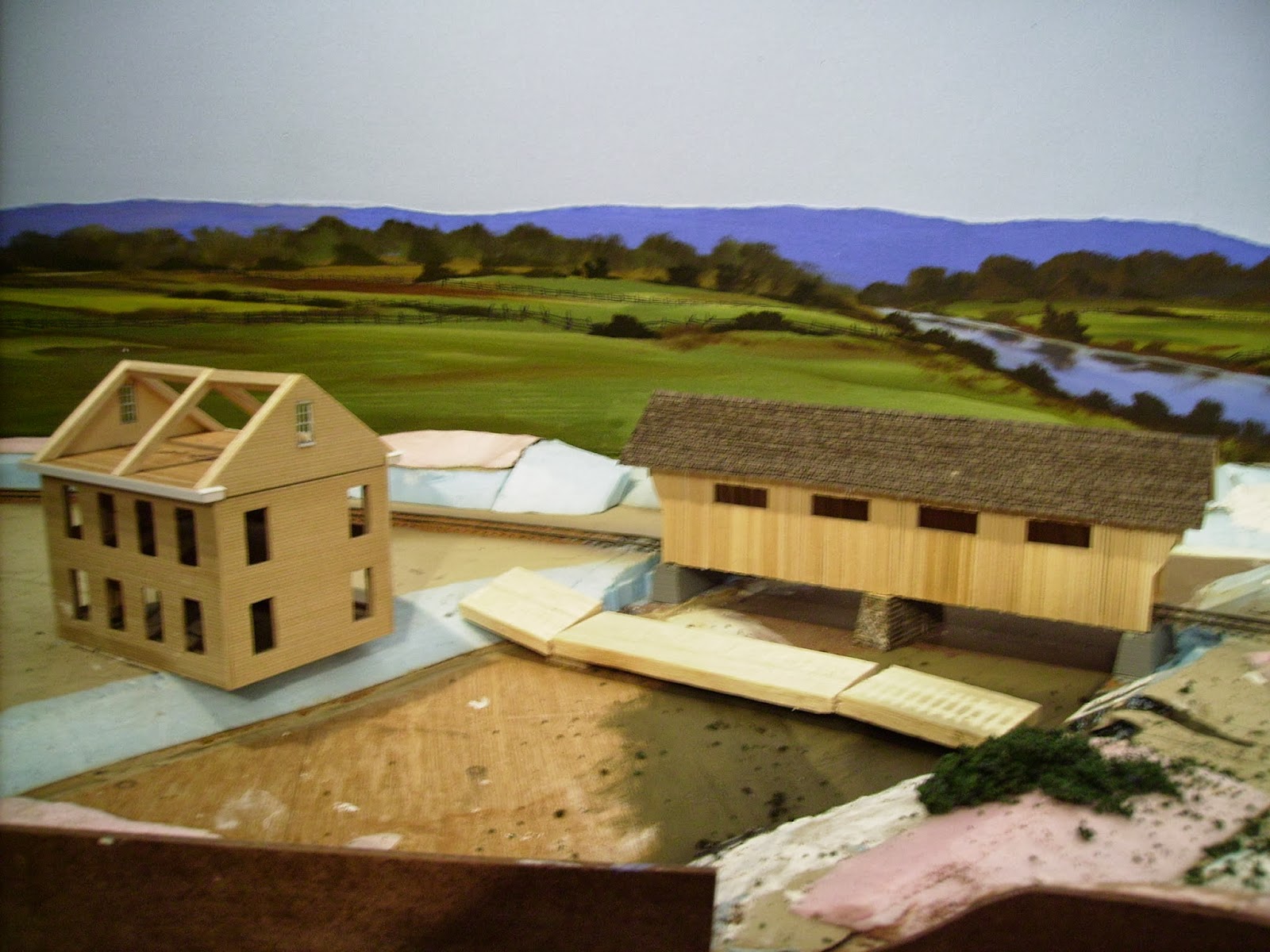
The balsa sections are the initial ideation for a wagon bridge that was actually there and nearly destroyed by Union cavalry. This crossing was a key ingredient for Gen'l Bragg and his Army of TN as they were attempting to close in for a battle with Army of the Cumberland. Here is the initial positioning of the Mill as the creek base is needing to be prepped for a pouring of Envirotex.

            Nearly a competed scene, landscaping and some structural details are to be added...
 
         A master at his best, true to form, he celebrates his progress and contribution. Nice slippers!


Thursday, October 31, 2013

INTERVIEW WITH BRIAN KAMMERER

Brian has been a part of this railroad scene since 2003 when he along with DC Cebula and Chris Brannigan came to visit at my home. It was our second time together, the first being Timonium - a neutral location that seemed most reasonable to all especially since we had a relationship only through emails. We of course hit it off and Brian offered to began painting the backdrop. His first foray was painting a 35'x3' canvas. Ever since then he has visited many times and continues to add backdrop scenes as the railroad evolves. April 29, 2013 I captured a few stories on how he began his interest in modeling the American Civil War. Hope you enjoy our interaction.

Sunday, May 6, 2012

DALTON CAR SHED
The only reference that I have located to this structure is mentioned by one of the raiders from the GLC, William Pittenger, in Craig Angles book. If you have not seen this reference before, Craig wrote "The Great Locomotive Chase" in 1992. No longer in print, Craig takes time to describe various areas along the chase route. In his book he includes this from Pittenger, "...the large passenger depot which had a shed over all the tracks..." So I went with a similar look to Atlanta. Chattanooga had a similar shed but slightly different construction materials and design. This structure holds the foreground on the North Branch (the layout). I decided to add some details given very visible location.

These two photos show early stages of Dalton and the car shed when I considered foam-core as the material. I decided on plywood after Chris' exasperations using this material for another structure. He is building the Barnsley scene found in the LABELS.


Shed Construction

On the left we're pretty along the way with the walls, roof supports and support columns already assembled. To the right shows the brick work. It is an adhesive paper by Clever. They have a very good website with a wide variety of stone, brick, siding and roof prints. You can purchase just the print  at a very reasonable fee and print any number of copies, or the adhesive backed sheets.

Two more views showing some of the wall supports and the most recent backdrop work from Brian Kammerrer. I invite you to view the new posting of Brian's work creating the backdrop scene as well, completing this and other backdrop scenes in 7 hours! More to come.


Thanks for following our work. Although we began in 2003 and await the arrival of the first sounding locos (still working out the bugs), the enjoyment never ceases.
BARNSLEY GARDENS AT WOODLANDS
THE GARDENS  


Christopher continues in his next phase for the Barnsley Mansion at Woodlands scene. The mansion has been completed and he is now building the gardens based on diagrams from the book. Nothing like having the research to authentically replicate a scene. Early construction of the mansion can be found in the list of LABELS in the right margin.


Diagram from Godfrey Barnsley's plan.
The view to the left is a diagram from Godfrey Barnsley's plan for his gardens. The author refers to this as the parterre "a formal garden construction on a level surface consisting of planting beds, edged in stone or tightly clipped hedging, and gravel paths arranged to form a pleasing, usually symmetrical pattern." Wikipedia. We simply copied and enlarged this diagram to a close-to HO scale with selective compression for a  reasonable fit. You'll notice this is pre-mansion given the structures illustrated. Barnsley had not yet built his home.


Gardens from the mansion's 2nd or 3rd floor.


    The  photo to the right is the gardens from the mansion's 2nd or 3rd floor. Although very post civil war, they stayed close to the original design concept. 


Below left you see Chris slicing hedges from Faller. Although a bit tedious as it is a fibrous foam product (nothing new for Chris), smaller lengths are a great fit. A foam-core base allows Chris to remove it while he constructs the garden. And to the right you see the addition of the first hedges and a sense on how the scene will come together. My wife, Ku'uipo, is looking forward to adding the flowering plants, ornamental trees and the green roses that Godfrey horticultured. She loves real gardening so those of you looking to involve your wife, significant other...

Chris slicing hedges from Falleraddition of the first hedges


Brian Does Dalton


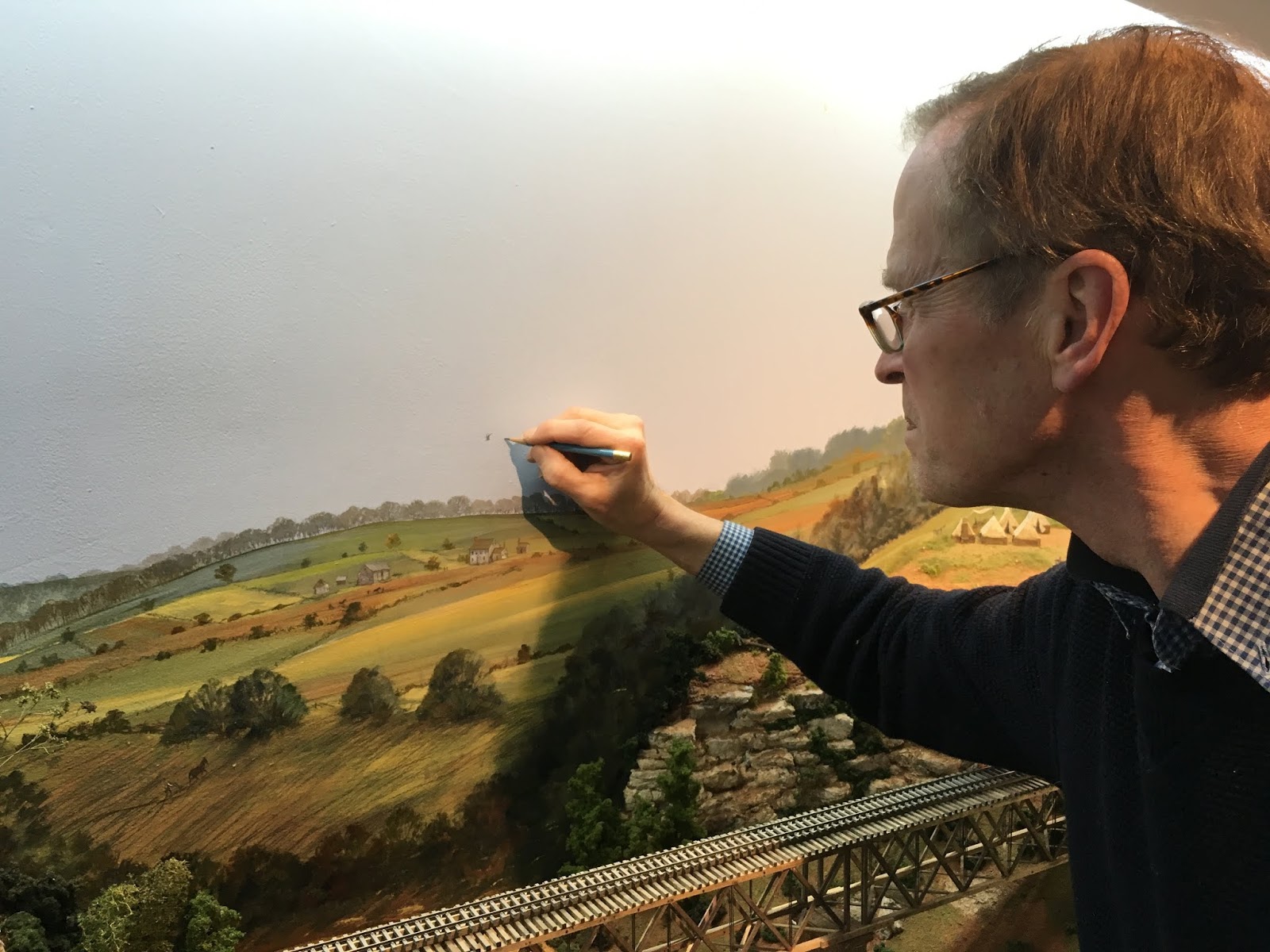
May 29 weekend the W&A had a fabulous visit from DC Cebula, Christopher Eldridge and Brian Kammerrer. In this upper view, Brian Kammerrer is sketching a backdrop for the town of Dalton.
He is working on a left over piece of canvas from a prior backdrop.

There have been no pictures of Dalton that I could uncover, even after a visit to the town, local libraries and a couple of local "historians". One source indicated that Dalton was a very up and coming town. A high looking set of structures would have taken a few visits for Brian to complete. We decided to go with a viable version of what was plausible to give the town a larger feel but not fully developed so I pulled photos on Chattanooga and other locations for references. 

Here Brian is beginning to paint in his sketches and bring life to black lined drawings. The third view below is the canvas taped to the backdrop. Along the entire area Brian also connected the ridges from the point of the peninsula, Rocky Face, to the other end where he painted Lookout Mountain.


Dalton's Role
Half way down the line on the W&A between Atlanta and Chattanooga, Dalton was a key location General Joe Johnston chose for the Confederate Army of Tennessee to defend in 1863. It was a small to medium size yard with a Car shed in a similar fashion to Atlanta. There was also a turntable on the north end but in my research to date, no engine house. Most of the information gathered on Dalton was from Craig Angle's book, The Great Locomotive Chase. If you are looking for a thorough journey into the entire story of the chase, not only has Craig researched the Chase but the players and the aftermath. About one half to two thirds of the content is told from the participants of that April 12 day in 1862.

Sunday, October 9, 2011

Anniversary Crew Tributes


Crew Shots


November celebrates the 8th anniversary of the Western & Atlantic RR, North Branch. In 2003 Dick Taylor of RailDreams and one of his modeling associates installed the 25 modules that began the life of this model railroad. If you are new to this site, north branch simply differentiates my W&A version from the magnificent layout by Lebron Matthews. Living in Georgia, Lebron's W&A is referred to as the south branch.

I have been able to call on many modeling friends who have made significant contributions to the evolution of my layout. As a bit of a tribute I made an entry yesterday of the members from the Garden State Central model railroad club. Here are some of my other compadres along with a few appreciative comments.

Rhett's talent is super detailing 19th century locos. He converted a Mantua General into a USMRR loco when I planned to include Union operations. View his work by clicking on the Label - Locomotives. Brian is looking at pictures of Atlanta for ideas on painting the backdrop panels. D.C. is taking his 243rd photo, that day.
Brian Kammerrer, Rhett Tyler, the Supt' and D.C. Cebula
Another vintage photo, D.C. and Lebron enjoy a moment of "Train Running for the Confederacy". D.C. and I cut out a section of benchwork for closer access to the Kingston yard. Here he is running his first train using an NCE throttle. The train belongs to Lebron. We were experimenting with operations but mostly discovered a couple of shorts and low voltage areas. Although a little disappointing, we knew where to make the adjustments.
D.C. and Lebron Matthews
Jerry was the proprietor of Keyport Car and Foundry and was a source for link and pin couplers. He was also a wealth of information on early railroading and offered excellent ideas, along with some provocative perspectives, on modeling. Unfortunately Jerry passed away a couple of years ago. We honor his contribution with an Obelisk in the Kingston cemetery.
Jerry Daub with Lebron
An example of the crew refusing to work! They think working for 10 hours with no break is a little much. Light weights! Actually they're on a break, observing as someone engineers a train on a recently completed stretch of main line.
Lebron, Brian and Christopher Eldridge
My lovely wife Ku'uipo, Hawaiian, supplying the troops with beverage and vitals.
She has also made a few dozen super trees which now populate Kennesaw Mountain.
Vintage indeed, a 2007 scene of D.C. framing backdrops. This is behind Big Shanty.

Finally we have Christopher posing with his new slippers cutting a fine figure indeed.