Showing posts with label Scenicing. Show all posts

Monday, August 18, 2025

Uodate on LeBron Matthew's Layout


 LeBron models the Western & Atlantic RR as do I. Hence, his model RR is referred to as the south branch, being that he lives in Georgia. 

Several months ago, LeBron had a new layout built by a local company. He has been quite busy and enjoying the scenicing phase. Here are his latest photos of his scenery work. 

Downtown Atlanta, Decatur Street...

On the outskirts ...

His selective compression of Atlanta. Although best seen in person, LeBron's modeling is in the master model railroader category. He is meticulous in his detailing to create authentic representations. He also paints his backdrop! Remarkably talented! 

We have been friends for over 20 years and have had many visits with one another, sharing building techniques, working on projects with each other, and the miseries of adding decoders, speakers, and motors to convert Mantua Generals to a prototypical look. But we certainly do have a whole lotta fun!!

Here is one from about 2004 at his original layout. Chris Brannigan is on the right, and he, along with LeBron, DC Cebula, Brian Kammerer, and I, are the original members of the ACWRRHS.


Brian met up with the General's curator over a few beers one night. The curator was gracious enough to allow us to have our photo taken on the pilot. He told us to stick around after the visitors left the Kennesaw museum, as the General is cordoned off. WHAT a treat!


Thursday, March 27, 2025

LINESIDE DETAILS

These are slides from a power point presentation i did to show all the possibilities for someone's model or virtual railroad.

The first slide indicates categories or areas. This is followed by slides of each category.


More to come. A slight technical difficulty prevented additional slides to upload. Please revisit another time.


Tuesday, September 6, 2022

Flat Figures by Brian Kammerer

Many, many months ago, I needed to scenic the area that increased in size as a result of opening up the aisle just south of Kennesaw Mtn. This area is at the top left corner between Kennesaw and where "Mill" is noted. The entire table of the Atlanta area is now parallel with the back wall and allows for a pleasurable 3' aisle.

I now had 3' feet of new real estate to scenic which I found artistically challenging and was a good thing. I had several ideas including a small farm, dirt road, double post and rail fencing. Mock up  structures were placed in the area. However, it all felt too busy.  Trains would be passing the Redoubt which has perspectives then a farm then mountain... So I just sat and pondered gazing into the bare benchtop. I would come back over a period of about 4-5 months. Interesting how the idea finally lands. I decided that I would create a deep perspective with distance. The backdrop / ridge line is foam core with a couple of layers of flocking. I would  need to show a 1000 yard or more distance from the ridge line to a full size (HO) foreground. 

This photo below shows the first steps to bridging the distance. At the base of the ridge line is a dark tree line. The intent is to show a tree line closer to the viewer and enhance the perspective experience. There are two figures in the middle ground. This is what I call "concept measuring" to ascertain plausibility for the entire scene. The cluster of trees is meant to be a view-through element. Once painted and flocked, I want the viewer to peer through the trees to help distribute the perspective as they see the scouts. The stream, and of course the house car, are the foreground. The fun of creating this scenic element is assessing what to place between the stream and the ridge line to foster the sense of distance.


Close up of the above photo...


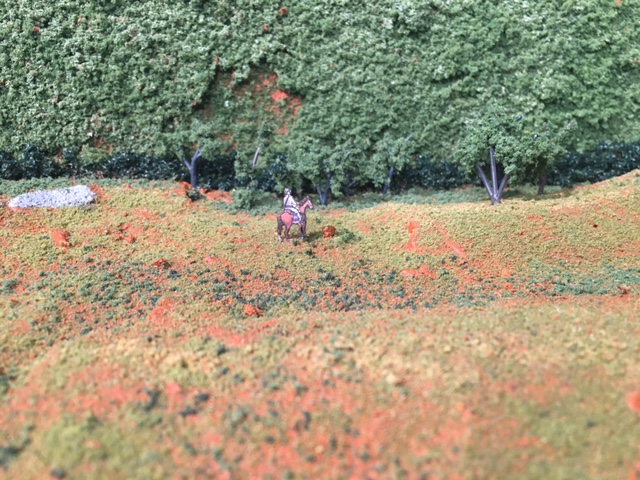
Even closer image below. The figure is another Brian Kammerer creation. His film "The Other Great Locomotive Chase" is populated with a plethora of flats. When I mentioned to him what I was doing he suggested flats. I had hoped he would. He graciously created a few sheets of infantry, cavalry and artillery figures. Everyone who has viewed this scene could not tell the scouts were flat.


One of the figure sheets Brain created is below. All I did was reduce the size then print a sheet. After cutting the figures I wanted, and adding a thin sheet of cardboard backing for rigidity, I simply glued a straight pin to the back. The bench is blue insulation foam, making installment of the figures very easy.  


I am getting ahead of my process.

While still in the imagination phase, and driving around on different days, one day as I was passing a field. I saw exactly what I was wanting to build. In the middle distance from the road there was a cluster of trees. The added component missing in my scene was the vegetation among these trees. Small, wild growing shrubs, bushes and some vines. Here is the nearly final touch, close up...


A more distant view...

I want to add more underbrush among the trees and in the open field. However, for the most part, I am quite satisfied with the results.

Tuesday, February 25, 2020

FEB 2020 OPS SESSION / SHAKEDOWN & PEACHTREE ST RENOVATION VIDEO

It's what can happen when my honey decides to go visit one of her friends for more than 4 days... INVITE THE CREW! In addition to DC and Andy, a very good friend and contributor was able to visit as well, LeBron Matthews. One day we will feature his remarkable modeling as he too models the W&A, referenced as the south branch. LeBron is from Columbus Georgia.


This crew was here on Wednesday working on different projects as well as to help prep for the Thursday night ops session. DC continues to scenic the new section. More on this section and DC's work in a future post.

 LeBron scenicing Atlanta; grass was more likely in many areas around the tracks and yard than I considered. Where there is no traffic most likely there'd be grasses. Needless to say, the added greenery has a few effects. 1) it pulls the elements of Atlanta together, the green is the connector to the structures. 2) it fills out the area of Atlanta; makes it "pop" as some like to say.
3) the color adds a pleasing invitation to the eye.

Andy took on his first structure, a Woodlands Scenics casting of the Tack Shed. The door off the hinge was his intention!
Six other fellas came by for the session. Adding LeBron and Paul, we grouped them into four 2-man crews, one engineer and one brakeman. In addition to operating the loco, the engineer handled the way bill/schedule. Brakeman had responsibility for coupling, switching. Here Lebron, engineer, along with his brakeman Paul, maneuver the Dr. Thompson consist into Big Shanty. DC and I were trouble shooters.

Engineers and Brakemen
Left to right, LeBron, DC, Ray, Paul, Bill, TR, Dave, Hilmar, Ed and Andy. Paul, Ed and Hilmar are from our local RR club, Garden State Central. Paul is building an HO scale W&A layout, focusing on the Battle of Mission Ridge. Ray has a MASSIVE HO multi-level layout, Norfolk and Western. Bill and Dave contribute to his layout and all three are members of the Model RR Club. Andy is our resident photographer and videographer. He excels at tree making ,and during this visit apprenticed with LeBron on scenic work.
Lessons learned or reinforced
1) Prior to ops session, have a friend review the schedule/way bills. We found out, 30 minutes prior to people arriving, the schedules included the same cars! During staging this was most apparent as one person set up a consist, went off to do another, only to return and find the cars he set gone!  
2) Always invite guests to offer feedback. Most often they will not offer input to avoid offending. This also shows them that your intention is to improve the efficiency and fun. 
3) Just because a person has done the brakeman job a few times does NOT mean they know how to engineer a locomotive! Although we are familiar with shorts, we had an excessive number this time. Speaking with one engineer at the end, I realized this engineer did not know that he could not run a loco into an adjacent turnout if the rails were not aligned to the track he was exiting! Good news is that this one breakdown indicated that we did not have a massive, layout wide, short issue to untangle.
4) Coupled with number 3, invite operators who are familiar operating on your layout. Then be sure to partner the most familiar with newest guests.
5) The realization that metal wheels can cause a short when the stub rails are either too close or wheel sets are too loose and hitting both rails simultaneously.


Sunday, September 8, 2019

KENNESAW ENTRENCHMENTS

Kennesaw Mountain was one of the more fortified areas protecting northern approaches to Atlanta as shown is these tow period photos and the Don Troiani painting "Thunder on Little Kennesaw" 
My dear friend DC Cebula, who has been an ongoing contributor to the W&A, is depicting a scene combing these three images. As recently as August 30, here are images of his work. As you can see a significant element to completion is adding the dense foliage.

Wednesday, June 8, 2016

KENNESAW ENTRENCHMENTS

Brief reminder that my railroad is set in the summer of 1863. The Confederate Army of Tennessee is bracing for an encounter with the Union Army of the Cumberland, led by William S. Rosecrans, around the rail hub of Chattanooga. September would see the battle of Chickamauga, the one great victory in the west for the Rebel army. However, they would experience a colossal defeat that November and retreat further south around another rail hub, Corinth Mississippi. William Tecumseh Sherman would lead two Union Armies, of the Cumberland and of the Ohio, into Georgia for one of the final phases of the Civil War. Sometime late 1863 through early 1864 defensive works were being constructed along the W&A, especially around Atlanta. We have created two specific scenes depicting the type of entrenchments based on period photos such as these. The first photo is around the base of Kennesaw Mountain. There is a terrific painting by Don Troiani of this area.
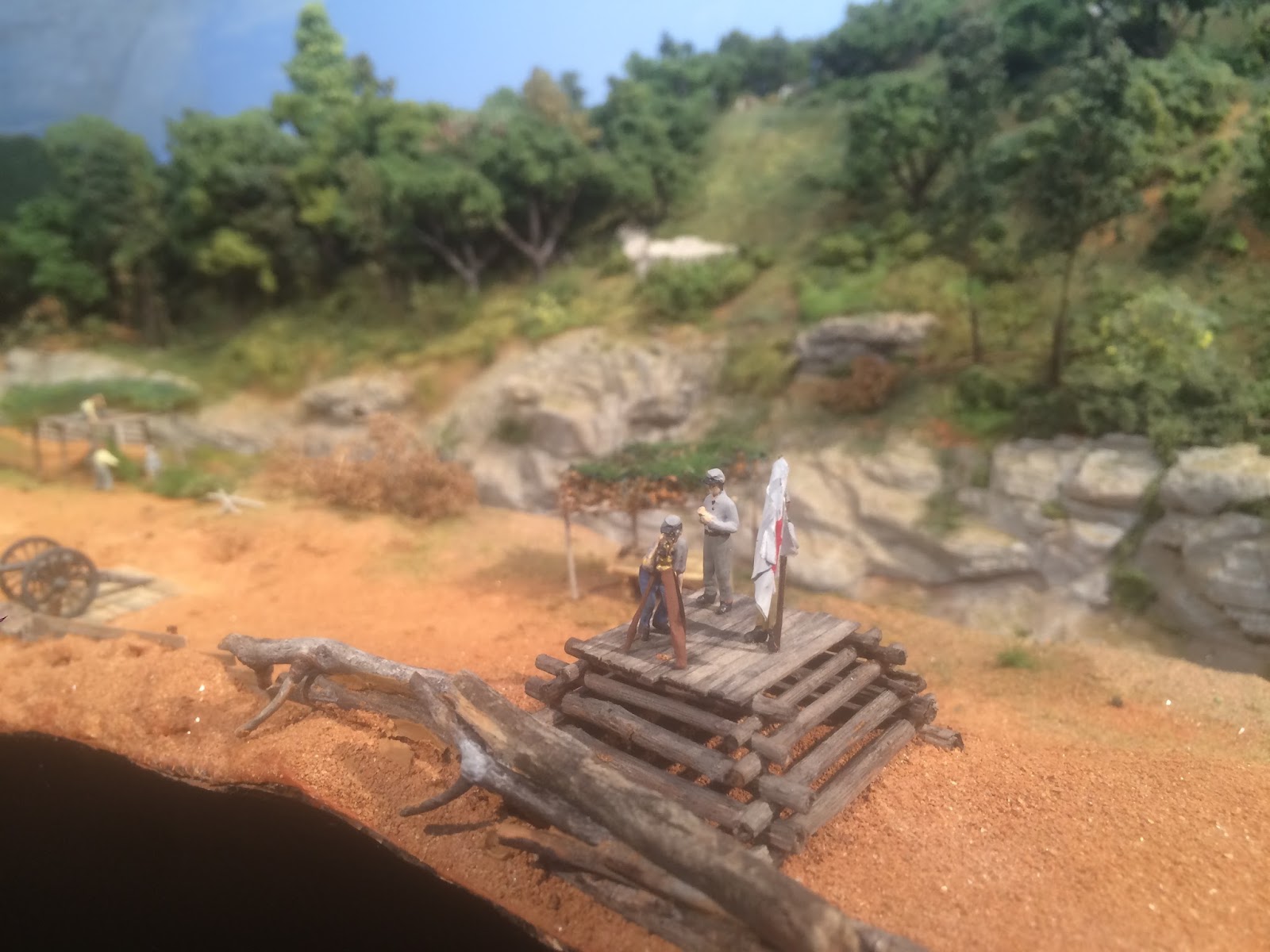
This scene below is a version of a signal tower of which there were many types depending on the terrain. Figures are Musket Miniatures and Prieser, the latter being modified as a Confederate soldier.
Here you see a few soldier boys constructing a "shebang", slang for a impromptu shelter from the elements. These were quite common in both armies, especially if the troops were stationed for a period of time.
A typical gun emplacement below. Notice the planks supporting the gun to avoid wheels being stuck in mud and for a steady foundation. The barricade is made from what is known as "gabions". These cylinders of wicker were filled with dirt and stone. This scene and the ones prior were built by D.C. Cebula.
Lastly is a "redoubt" or breastwork usually outside of a fortification. There were many of these along the perimeter of Atlanta. This was built by LeBron Matthews. Most figures and all the fortification details of all these photos are from Musket Miniatures and Models.

Saturday, May 16, 2015

LAYOUT OVERVIEW

After receiving several requests for a photo or two of the entire layout, I thought I'd share this in the traditional MRR format.


November 2003: The Benchwork, of which there are 25 sections, was built by RailDreams out of Wisconsin. They laid 95% of the track and wired the layout with the DCC system.


Size: 21’ x 35’      Height: 48”

Prototype: Western & Atlantic RR, Atlanta GA to Chattanooga TN

Era: 1863, August

Style: Walk-around; point-to-point

Benchwork:  1.5” pink insulation foam board over ¼” Luan

Track: code 83 Flextrack

Mainline: 130’

Minimum radius: 18”

Minimum turnout: no. 4; Shinohara; stubs by BK Enterprises hand laid

Scenery: Plaster, Sculptamold over plaster cloth or cardboard strips. Ground cover – GA red dirt… yes, from GA

Backdrop: painted ¼” Masonite

Switch machines: Tortoise

System: NCE DCC tethered and wireless

Structures: BTS, Railway Design Associates, DPM, Bar Mills, Main Street Heritage, Branchline Trains. 36 are scratch built from photos and illustrations.

Figures: Musket Miniatures, Prieser, Airfix, Thomas, Merten, Model Power, Life-Like

First off, the reason for calling this the 'North Branch' is that fellow modeler and contributor, LeBron Mathews, also models the W&A… in Georgia. Hence we refer to his layout as the  ‘South Branch’. 

Additional contributors include:  
  • DC Cebula (MANY, MANY scratch built structures, bench work modifications, scenery)
  • Christopher Eldridge (Lee & Gordon’s Mill, Barnsley Gardens, blockhouse)
  • Brian Kammerer (backdrops) 
  • Andy Salcius (trees, structures, videos and fascia skirt)
  • Chris Comport (structures) 
  • Brent Pearson and Pete Culos (figures)
  • Garden State Central Model RR Club, in particular Jim Judge, (track work and electrical) 
  • Ku’uipo L. Radice (trees and crew vittles)
TRACK PLAN
Here is my design after about 30 iterations back in 2003. Last month Bernie Kempinski took this plan, which was done in pencil, and using a graphic software drew up the table top with track. 


Below Bernie did a beautiful job adding scenic contours, towns, etc. which gives the viewer a more complete sense of the floor plan.

In the beginning... DC and I cut away two areas of the bench. The first photo below shows the original Wye bench work as delivered and reconstructed by the folks from RailDreams. I contracted with them to complete the tables, install track and wire the entire layout. I knew relatively little then and thought this would speed up the process. It did. However, you know the story, knowing what I know now I... 
Here the reach was clearly too far and required change.
 
This next photo shows reach enhanced by trimming the bench and re-routing the track, all with the help of my good friend DC Cebula.
Track heading to the top of this photo is going south to Big Shanty and Atlanta. Track heading to bottom left goes north to Dalton and Chattanooga. Bottom right goes to Rome, GA. The Rome RR is one of six interchanges built into this layout including ET&G (East TN & GA), the M&C (Memphis and Charleston), N&C (Nashville & Chattanooga), A&WPt (Atlanta & West Pt.), GRR (Georgia RR) and M&W (Macon & Western). One plan is to build a gate to provide staging from Rome. We'll See!

Due to the selective compression requirements, you can get an idea on how we needed to alter the plan based on this diagram. This also shows the placement of locomotives during The Great Locomotive Chase. The General might very well have made it back to Union lines had it not been for the extra trains coming out of Chattanooga, marked here as the Second and Third Sections. Locomotive William R Smith did participate in the Chase until Bill Fuller met up with the Texas.


Two of my favorite people and contributors, DC and Lebron, April 12, 2007 conducting a test run.


Friday, April 17, 2015

GROWING TOBACCO

When considering your options for a layout a key ingredient, for me, is to have a plan or at least an idea of the different scenic elements to feature. 18th century tobacco was most associated with Virginia, North Carolina and Kentucky. Georgia was known for a variety of other crops. By the 1860's, in addition to cotton, wheat, corn and others, tobacco came into its own. 
Last week a tobacco field was added to the W&A, NB. After searching for a reasonably priced and yet good looking model I chose the Alkem plants. These are etched brass laser cut kits. 


Above you see one of the Alkem brass sheets with the laser and etched brass plants. There are enough pieces to make about 2 dz. plants. I use mostly three layers and some with four. The sheet was primed with an automotive spray paint then, as per instructions, a medium green on both sides. The top was then hit with a gloss coat to bring some life to the look. The brass rod protruding from the pink foam is the future stem. I decided to build them in this manner because the leaf layers will sit perpendicular once cemented with CA glue, about a pin head amount. 
I then slightly curl a few leaf ends with needle nose pliers for a little 'texture'. You can see that I left the stems about a half inch longer on top and about an inch on the other end to be able to handle. When complete, cut the stem above even with the plant and leave about 3/4" below. If installing in this type of foam, although the brass wire is 1.010, I use curve tipped tweezers; hold the bottom stem tip and wiggle the point into the foam. No glue required especially if you want to remove them. You can also make the field off-layout then insert the whole plot.
This is about half of the area where tobacco will be planted. Notice the tobacco shed in the background. That is a beautiful kit of the same name by BTS (better than scratch). 

Tuesday, December 3, 2013

Chattanooga Progress, posted Dec 10, 2014

Here are the latest photos of progress in Chattanooga. Our last posting of this section showed only a few mock ups and maps.
Below you see the addition of the Adams Express CO. and the Crutchfield House, the nearby hotel to the car shed, shown here as the white mock up in the background. 
DC added the platform. Although the platform is not shown in any diagrams that we've researched, nor is such a structure mentioned in any reading, for the purpose of a model railroad we included it for operations.
This photo is looking south, opposite from the above shot. We are 90% complete on this section. Other details and perhaps another commercial structure could be added in the open space at left.
Chattanooga was a terminus for the W&A and Nashville and Chattanooga lines. Later the East Tennessee and Georgia RR was added. The Memphis and Charleston passed through Chattanooga. Given that all these lines came into Chattanooga there are many possibilities for model railroading operations. 
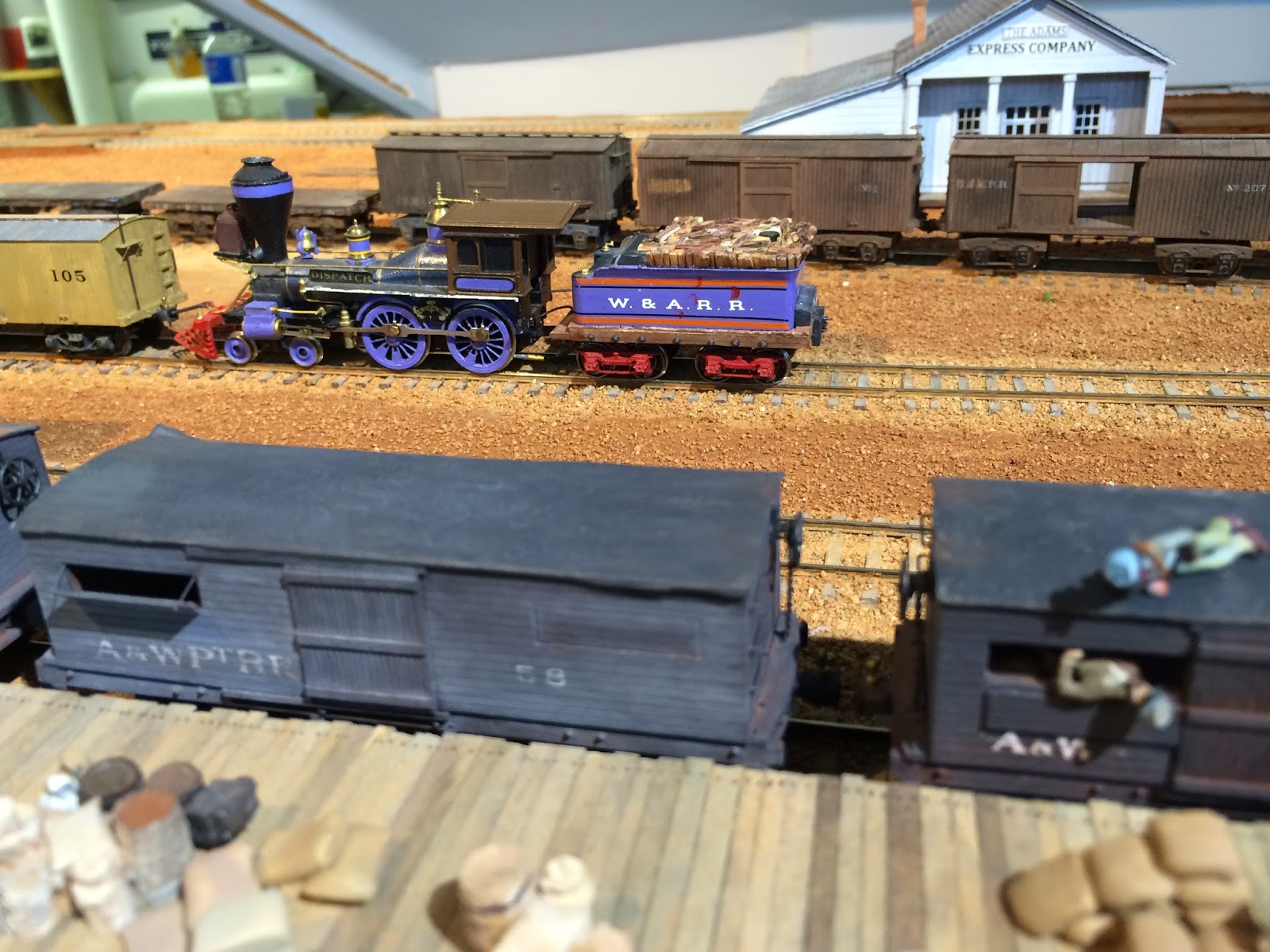
The yard was filled with cars from different lines for the sake of the photo. These other rail lines are the Atlanta and West Point, Macon and Western and Georgia RR, all of which came into Atlanta.
These last two photos below show the scratch built Adams Express Co. and Crutchfield House, built by Chris Comport.


Consolidated

As with most model railroads a key element is selective compression. Here is a map, from our late contributor Zoe who was constructing a virtual W&A of the period, showing the rails into Chattanooga. There are two distinct features. One is the 2 tracks entering what is known as the Car Shed or passenger station. The other is the Wye track formation used to reverse locomotives. There was also a turntable in Chattanooga which appears in the next illustration below.


This drawing below showing the turntable is from a book entitled The Union Railyards Site, Industrial Archeology in Chattanooga, Tennessee by R.B. Council and Nicholas Honercamp. It was attached to the center track between the Car Shed and the other rectangular structure, the W&A Freight Depot, to its right. According to the authors, this is "The Federal plan of Chattanooga, 1863" and was from F.W. Dorr's 'Chattanooga and Its Approaches,' drawn after the battle of Chattanooga in November 1863. I chose to include the turntable, not the Wye since my space was too limiting.
Right and center is a notation, Battery Hazen, and was also know as Stone Fort. We have a tentative plan to include a portion of this fort at the layout edge.
Below is a photo taken from the area in the foreground known as the Stone Fort. So far there are no other details about this feature making it a creative endeavor for the layout. There is also mention of a Judge Hooke's residence in this view. Although barely visible, it was located in the grove of trees in the left background. This structure is being scratch built by D. C. Cebula. 

There are many interesting buildings to be considered. I chose prominent ones including a hotel known as the Crutchfield House, the Adams Express building and the home owned by Judge Hooke. Here is D.C.'s version as an HO structure, emphatically informing me that "...the chimneys are going right there!", as we debated the location given the photo. You decide and let him know... PLEASE.

These two photos of Hooke's residence were taken post war an deduced that the enclosed balcony was post war as well. As D.C. has completed the basic structure, next are the detailed elements and landscaping. One anecdote is that when Chattanooga residents were evacuating, the Judge was provided with his own house car to remove his personal belongings.


For the Car Shed I connected with Alkem Scale Models, http://www.alkemscalemodels.com (Bernie Kempinski) to laser cut and construct the building primarily for the exactitude given the numerous arches and trusses. 
Here is a period photo followed by Charlie Taylor's model. He is building the Memphis & Charleston R.R. in O scale. Here is a link to his site, jcharlestaylor.com/taylorSPECIALtrains.


The Crutchfield House in mock up...

This will be scratch built by Christopher who has also done the Lee and Gordon's Mill and the Barnsley Garden Mansion. Both are featured in previous blog posts and in our Labels section.
Here is a long view to compare with the 2 maps at top of page... Photo is taken from the Wye area and the Stone Fort site.

Adams Express is in the early stage of mock up. It was situated between the Shed and Crutchfield House. Here's about a 20x, zoom from a period picture: