My good friend Andy Salcius was here a few weeks ago and posted this video he took of the most recent excursion through Georgia on the W&A. A few things to note is that the landscape and structures are period in that they have been extensively researched. Most structures are either scratch built from period photos, illustrations and/or diagrams. The time is summer 1863. Chattanooga was on the verge of being captured by the Union Army of the Cumberland, led by General Rosecrans. Locals were evacuating to points south while Confederate troops and military supplies were be transported both north, from Georgia, and south from Virginia to meet the Yankee incursion. They were to eventually meet the Union army at a place called Chickamauga Creek were the south would experience its only clear victory in the western theater of war.
Tuesday, May 24, 2016


Thursday, April 14, 2016
W&A Roundhouse - Pano
New fun with the iPhone camera. My good friend Andy Salcius was here for a couple of days. His first project was setting up this blog. He has taken many photos and videos subsequently of the layout. For this visit we experimented with panoramic photography for something slightly different to experience. He started with the idea to make a small pivotable jig. After several renditions we landed on this rig. It appears to be on a platform/flat car. That is correct! It was the first scratch built car I attempted about 25 years ago. The base however was two angled bolsters which caused it to tip left or right. He added the four posts to stabilize and high enough to hold his iPhone. Inside the car is an inverted deck made 3D by Andy when he worked for Makerbot. The inverted deck being too unstable I found the car as a sturdier base.

Here is photo of the jig in service that Andy created. We added a few shims to ensure stability.


Here is photo of the jig in service that Andy created. We added a few shims to ensure stability.

Photo below is about the 10th shot after experimenting with different Jerry-rigged jigs and using the one shown above. 
Of course this view is premature in that my research
continues to find some information on what the interior may have looked
like during the war years. So far, thanks to the folks at the B&O Museum, the Savannah
Railroad Museum and a period photo from Dave Bright (csa-railroads.com) of the Petersburg Roundhouse, I am ready to begin adding elements. These will include one or two winches in bays, gas lamps in some of the bays, a load of work benches, shelving and more debris from general maintenance.
Friday, March 4, 2016
STRUCTURES & SIGNS
With much of the layout completed, I am now focusing more on structure colors and sign designs. As many of you probably know, color is one of the most challenging, and sometimes perplexing, elements to recreate. In addition to cruising model railroad blogs and sites, one source for ideas has been "The Civil War In Color". Here is one taken on PA Avenue during the Grand Army review at the end of the war.
 This one below is a store near Ford's Theater. There are several very cool details to consider. One is adding small signs as on the columns. Another is adding a larger sign such as the one saying "Family Circle". Then there are the drapes and the green balcony railing, One other consideration is attaching a gas lamp as shown below. Another element is the fogged window panes. Makes it easy to avoid detailing an interior!

Although one could challenge the accuracy of either or any, such is the case in most colorized or even suggested colors in any period photo. However, these provide enough plausibility to copy for my purposes. I also read that most structures of this type had three colors, making for some fun combinations.
My town of Dalton now has my attention as there are several buildings that have been waiting for an identity! Below are two buildings that have made the transition.
 For the Cherokee Insurance Banking Co. I decided on these darker colors since this is a formal business structure. To construct the sign, I first measured the space dimensions on the building. I then perused many font options that I had seen in other photos and came up with Algerian. It took a few tries to get the font size to a correct height. After a few test fits the sign was printed on my computer using typical copy paper. It was then cut to size measured earlier. Next was to cut a piece of Evergreen styrene for the backing. I chose .010. I then framed it with .040x.040 strips which provided a frame for the actual sign. The next to-do's are window treatments, and then the next challenge - what to do for the show windows on the ground floor! One idea is to find a color photo that could give the illusion of an interior that is simply pasted or glued onto the inner side of the window. Another option of course is to add an interior with a light. Hmmm?
Photo below is a paper flat that DC Cebula expanded upon adding a chimney on the right. He then built a slight addition to give it a 3D perspective. One most attractive additions is his detailing of the roof trim. The sign was made in a similar fashion to the Cherokee Insurance Co above.
Both signs are black lettering on white paper. The frames were painted black with craft paint. I weathered both with Doc O'Brien's powders. For this one I used brown and yellow.

 Another source for signs is the movie 'Horse Soldiers'. In particular are the scenes at Newton Station. There are at least a dozen signs shown. Some are painted directly onto the building. Others are on a framed placard and there's one or two hanging. You'll see a few store windows painted with such titles as BAR. I'd guess that there is also eight or so different fonts. I am currently surfing the web to find font sources. However those that come with Windows have provided a decent variety for now. In addition to the Algerian I also use GungsuhChe, Bell MT, Baskerville Old and High Tower Text.
You can look for other font types on our civil war railroads yahoo site by John Ott.
Lastly, I have been having TOO much fun making signs now that I have found a few more ideas for working with decals. This brings me to sharing with you a fabulous HOW TO book by Kalmbach by two of the best and well known model railroaders, Dave Frary and Bob Hayden. I Most enthusiastically post the cover here:


Although one could challenge the accuracy of either or any, such is the case in most colorized or even suggested colors in any period photo. However, these provide enough plausibility to copy for my purposes. I also read that most structures of this type had three colors, making for some fun combinations.
My town of Dalton now has my attention as there are several buildings that have been waiting for an identity! Below are two buildings that have made the transition.

Photo below is a paper flat that DC Cebula expanded upon adding a chimney on the right. He then built a slight addition to give it a 3D perspective. One most attractive additions is his detailing of the roof trim. The sign was made in a similar fashion to the Cherokee Insurance Co above.
Both signs are black lettering on white paper. The frames were painted black with craft paint. I weathered both with Doc O'Brien's powders. For this one I used brown and yellow.

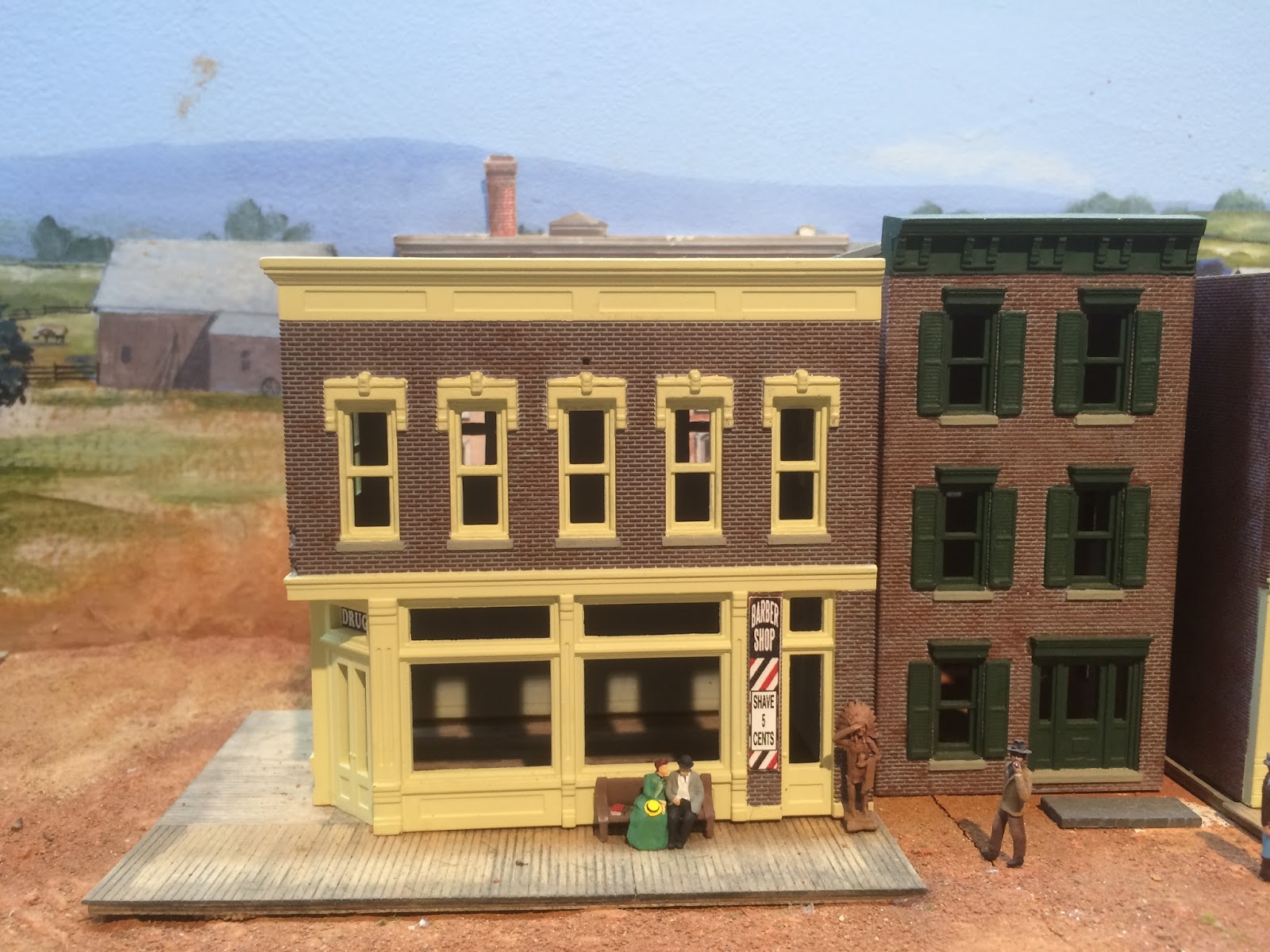
Next in line is this Drug Store and barber Shop. I am considering a third color but not sure which. Of course these windows need their treatments and some semblance of an interior. The building to the right is a residence of one of the town doctors. We will add a small front yard and fence, perhaps a flower bed.
You can look for other font types on our civil war railroads yahoo site by John Ott.
Lastly, I have been having TOO much fun making signs now that I have found a few more ideas for working with decals. This brings me to sharing with you a fabulous HOW TO book by Kalmbach by two of the best and well known model railroaders, Dave Frary and Bob Hayden. I Most enthusiastically post the cover here:

Tuesday, January 12, 2016
Roundhouse Flooring Completed!
If you have visited prior postings of my ambition to add flooring, here is a photo of the final result! If you have not seen the build up, my research showed that roundhouses at this time did have wood flooring. I thank the folks at the Savannah RR Museum for their assistance. After many hours of fitting the scribed siding, I am pleased to show its completion...

Above you can see two tracks with pits installed. Of course these were to conduct maintenance on the under belly of the locomotives.
There is one photo of the Georgia roundhouse, below, revealing that each track had a maintenance pit. I considered reproducing this element... until I did one and immediately did a 180 on that decision. Hence, I did only two to simply offer the idea as to how these would have looked.


Above you can see two tracks with pits installed. Of course these were to conduct maintenance on the under belly of the locomotives.
There is one photo of the Georgia roundhouse, below, revealing that each track had a maintenance pit. I considered reproducing this element... until I did one and immediately did a 180 on that decision. Hence, I did only two to simply offer the idea as to how these would have looked.

Re-purposing Car Weights
Building an authentic replica of a civil war railroad requires LOTS of scratch building. The use of various weights has always been helpful to hold pieces in place as glue dries or to hold them as you measure for accuracy. I have purchased a few from Micro Mark for this reason. Last year I needed additional weights IMMEDIATELY. As necessity can be the mother of invention, I recalled that over the years I accumulated Mantua car weights, removed to reduce the weight of cars in order to enhance pulling capacity for my Mantua General's. Although prior to the war, train consists were 2 to 4 cars, many railroad buffs think that during the war locomotives did not pull more than maybe half dozen. However, during the war requirements for materials and troops pushed their limits. Records show that train consists topped 20 even 23 cars. Often these were loaded and sometimes requiring double-headed power.
Twelve to fifteen years ago only Mantua cars were available. Today we now have several manufacturers that produce very authentic laser kits for a variety of rolling stock, such as BTS and ALKEM. However, enticed by this opportunity to operate longer consists, I replaced the heavier weights in the Mantua cars with lighter ones.

 Nearly two dozen cars later I had a stack of these long, rectangular pieces of metal that I'd use two or three at a time. Then the bulb lit!
 As you can imagine, any car weights can be re-purposed for such a tool...

Twelve to fifteen years ago only Mantua cars were available. Today we now have several manufacturers that produce very authentic laser kits for a variety of rolling stock, such as BTS and ALKEM. However, enticed by this opportunity to operate longer consists, I replaced the heavier weights in the Mantua cars with lighter ones.

 Nearly two dozen cars later I had a stack of these long, rectangular pieces of metal that I'd use two or three at a time. Then the bulb lit!
To wrap these in any stack configuration with good, ole, reliable duct tape!


HAPPY RAILS!
Saturday, December 19, 2015
M&C RR Update
I know, I know, not much of the W&A recently. However, I can not pass up the opportunity to show the latest progress on Charlie Taylor's O scale M&C. Below is one of two photo updates showing the Memphis Depot.

 The extraordinary aspect of this and the next photo of the Huntsville Roundhouse is that I initially thought these were laser cut as are several of the M&C structures. Actually these are scratch built. Charlie Curro is the master craftsman who has done many of the M&C buildings. The doorway detail is truly spectacular.
This one below is the Huntsville Roundhouse, also scratch built. Please note that the roof is metal!
 Next post will be a tip for discarded car weights and recent photos of work on my W&A Roundhouse.


This one below is the Huntsville Roundhouse, also scratch built. Please note that the roof is metal!

Tuesday, December 1, 2015
Sunday, October 18, 2015
Crew Shots
A view into the past of the different contributors to the layout..., about 2005 or 2006.
Below, Brian Kammerer, Rhett Tyler, yours truly and D.C. Cebula.

 Brian, circa 2007, painting one of the three panel backdrops to Atlanta.


Below, Brian Kammerer, Rhett Tyler, yours truly and D.C. Cebula.

Here's D.C. from about 2005 or 2006 lining up the backdrop frame behind Big Shanty. D.C. has done almost every aspect of construction. Next, I hope, he will take on my least favorite area... ELECTRICAL!


The crew who have made this layout what it is today. Each person is a master in their own craft, humbly speaking of course.
Myself, Brian from Connecticut, LeBron Matthews from Georgia, D.C. from Delaware and Christopher Eldridge from the Philadelphia area who built three iconic structures, the blockhouse, Lee and Gordon's Mills and the Barnsely Mansion and gardens.

Wednesday, October 7, 2015
Memphis & Charleston RR - NEW PHOTOS!
Just received these photos from Charlie...
If this is your first visit, these depict an O scale model railroad by Charlie Taylor and his crew. He and his railroad live in the Memphis area.
 W&A Depot


Charlie Taylor and crew have been pounding rail and laying bricks as they continue their work on the Memphis and Charleston RR, figuratively of course. As some of you may know, Charlie's line is O scale and they have been building since 2010. His roundhouse stable and rolling stock inventory includes equipment from SMR and BTS models. He, on rare occasion, sends me a text with a photo or two of progress. One of his key collaborators is Carlie Curro who builds structures, primarily. There is also nephew Will Shirey who is the backdrop artist.
Here are a few of the latest images I received from Charlie, one as recent as this week.
This is the famous Crutchfield House, the hotel a short distance from the Car Shed. It was here that then President Jeff Davis gave a speech to a crowd off the balcony to the left of this view in 1861, maybe '62. Nearly all of the structures are laser cut. By the way, the Car Shed on left with curved roof... its about 5' long!
 Charlie's layout is housed on the second floor of his 3 car garage, the 2nd floor built specifically in mind for this magnificent O scale model railroad. The M&C line includes significant stations in Memphis, Corinth, Huntsville, Stevenson, Shellmound/Nickajack, and Chattanooga with additional water stops in Germantown, Bridgeport and Whiteside.
He uses Fast Tracks turnouts as they have mastered turnout forms and templates which expedite the laying of track.
 Above is a model of the cave where the dirt was used to make saltpeter for the making of gunpowder. This was an area in Tennessee known as Nickajack as was the largest single domestic source of saltpeter for the Confederacy. I suggest clicking on the image for a larger view. This is not a painting but a 3D model, and this cave is quite huge; O scale!
Below one of SMR's 4-4-0's with a few of their freight cars, passing at the foot of Lookout Mountain.

If this is your first visit, these depict an O scale model railroad by Charlie Taylor and his crew. He and his railroad live in the Memphis area.
Chattanooga Car Shed
 W&A Depot
Chattanooga Blockhouse

Trestle over Running Water Creek Bridgeport, AL

On the M&C crossing the TN River Bridgeport

Leaving Chattanooga for Memphis

Outside of Corinth, MI

Stevenson, AL

Huntsville Turntable

The Train Room

Charlie Taylor and crew have been pounding rail and laying bricks as they continue their work on the Memphis and Charleston RR, figuratively of course. As some of you may know, Charlie's line is O scale and they have been building since 2010. His roundhouse stable and rolling stock inventory includes equipment from SMR and BTS models. He, on rare occasion, sends me a text with a photo or two of progress. One of his key collaborators is Carlie Curro who builds structures, primarily. There is also nephew Will Shirey who is the backdrop artist.
Here are a few of the latest images I received from Charlie, one as recent as this week.
This is the famous Crutchfield House, the hotel a short distance from the Car Shed. It was here that then President Jeff Davis gave a speech to a crowd off the balcony to the left of this view in 1861, maybe '62. Nearly all of the structures are laser cut. By the way, the Car Shed on left with curved roof... its about 5' long!

He uses Fast Tracks turnouts as they have mastered turnout forms and templates which expedite the laying of track.

Below one of SMR's 4-4-0's with a few of their freight cars, passing at the foot of Lookout Mountain.

Tuesday, September 29, 2015
ACWRRHS Spetember 2015 Annual Meet

Below is Bill Aldrich, a volunteer guide and authority on the Gettysburg train station and an extraordinary model builder. Here he is showing us his G scale model of the 4-4-0 Conewago which pulled the car carrying then president Lincoln to Gettysburg for the consecration of the national cemetery where he read the famous Gettysburg Address. Bill scratch built the 4-4-0 from the actual plans... and I do mean scratch including working levers, double cross head guides and an engineer who he fashioned from a photo of the actual engineer.


Once there, click on Photos, then Albums and click open 2015 MEET. There are other photos showing N scale modules built by Joel Salmons and Paul Dobbs as well as beautiful G scale models of flat cars hauling artillery most of which was scratch built by Dennis Lenz. Here is one shot of him with Gerry. That's Paul, red shirt, and Joel in the background.

Subscribe to:
Posts (Atom)